
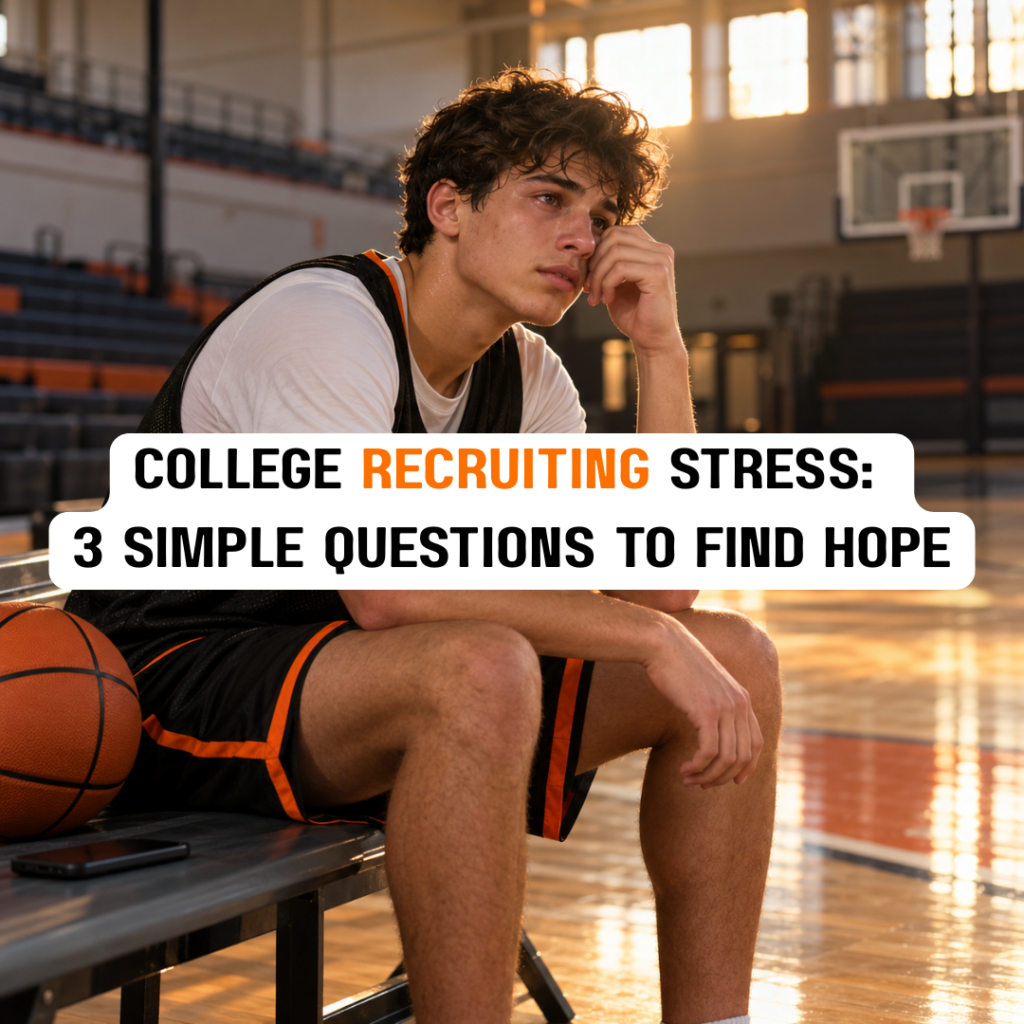
“I just want it to be over.”
He said it quietly. Then he wiped his eyes.
It was this past Wednesday night. Across from me sat a Class of 2027 basketball player (we’ll call him “J”) who I’ve met with almost every week since 2023.
I’ve seen him nervous.
I’ve seen him frustrated.
I’ve seen him angry after a bad game.
I’d never seen him like this.
College recruiting stress does this to young athletes. I’ve watched it happen more times than I can count.
Never to someone who has worked this hard for it.
Three Years of Work, Then the Wait
When we started, J was a quiet freshman. Three years later:
From quiet kid to mature athlete.
From freshman newcomer to big contributor.
From under-sized guard to college basketball recruit.
There were cracks along the way. Moments when the doubt crept in.
“Will I ever get to play college basketball?”
Every time, I gave him the same message.
Control what you can control.
Play basketball.
Get better.
The process will take care of itself.
He believed me. He put his head down and went back to work.
And for a while, it looked like the process was taking care of itself.
Earlier this month, his dream school invited him for an overnight visit.
Excited.
Nervous.
Hopeful.
This could be it.
He went hoping to come home with an offer.
He didn’t.
Five recruits visited. Two spots.
No yes. No no. Just more waiting.
That’s when college recruiting stress hits hardest: when there’s nothing left to do but wait.
When the Things You Can Control Run Out
And here’s the hard part. The things I’d told him to control are running out.
No more AAU games.
One more high school season.
Not much time left on the clock.
Yes, he can keep getting better. But right now, that’s more for his sanity than his college prospects.
Then there’s the other school.
J has an offer. A real one, from a program that wants him.
You’d think that would bring relief. Instead, it brought conflict.
His parents don’t think it’s the right fit.
Academics? Eh.
Location? Not ideal.
What they pictured for their son? Nope.
J wants to make his own decision. His parents don’t want him to make the wrong one.
Both come from love. That’s what makes it so hard.
So J is stuck.
He’s waiting on the school he wants. He’s holding an offer his parents don’t want him to take. He’s caught between his dream and the people he loves most.
No wonder he wants it to be over.
3 Questions That Ease College Recruiting Stress
So where do I fit in?
I listen to both sides.
I make sure his parents know I have their son’s best interest at heart. I also make sure they understand my job, which is to help J work through this in a way that works for him.
But on Wednesday night, my job was simpler.
Help a young man breathe again.
So I asked him three questions.
“What helps take your mind off recruiting?”
He didn’t hesitate.
Playing basketball.
Watching the NBA.
Hanging out with his friends.
Do more of that, I told him. Those things aren’t distractions. They’re helping you.
“What can you actually do to move the process forward?”
With his dream school? Not much. The ball’s in their court.
But with the school that offered, he can do his homework.
- Talk to the players.
- Learn about the program, the classes, the campus.
- Find out for himself whether it could be a fit if the dream school doesn’t come through.
That’s not settling. That’s taking back a little control.
“What if your top school comes through?”
He paused.
“It would feel great.”
I told him he doesn’t have to feel positive all the time. In the quiet moments, it’s okay to worry.
But he’s allowed to hope, too.
Hoping isn’t setting yourself up for disappointment. It’s fuel. (I wrote more about the power of “what if” here.)
J didn’t leave with an answer.
The dream school hasn’t called (yet). The conversation with his parents isn’t finished.
But he walked out with something he didn’t walk in with. A few things he can control. And permission to hope.
It isn’t over. But for the first time in weeks, he didn’t need it to be.
How Parents Can Help With College Recruiting Stress
So, what does this have to do with you?
If your child is facing a big decision, like choosing a college, making a commitment, or transferring, you might be in J’s parents’ shoes right now. College recruiting stress doesn’t just affect the athlete. It affects the whole family.
Wanting the best. Afraid of the wrong choice.
Here are three ways to support your child (and yourself) through it.
- Find out what matters to them. You have the life experience to help them choose well. But what you want and what they want aren’t always the same. Learn what they value most.
- Remember being 18. Would you have wanted your parents to make your college decision for you? Almost certainly not. Try to see it through their eyes, even when you can spot a blind spot.
- Ask “what if” the good way. What if your child has the motivation and character to make the most of whatever they choose? What if giving them the decision is exactly what helps them succeed, even if it isn’t the choice you’d make?
One challenge this week: Get curious. Ask your child what matters most to them. Even if they don’t know yet, the question moves them closer to an answer.
Frequently Asked Questions
What causes college recruiting stress?
Much of it comes from waiting on decisions athletes can’t control: offers, roster spots, and timelines set by coaches. College recruiting stress grows when an athlete’s sense of worth gets tied to the outcome, or when family members disagree about the right choice.
How can athletes cope with college recruiting stress?
Focus on what’s still in your control, like researching schools, talking to current players, and taking care of yourself. Make time for the things that take your mind off recruiting. And let yourself hope, while accepting that some worry is normal.
Who should make the final college decision, the athlete or the parents?
Ideally, the athlete makes the decision with their parents’ input. Parents bring experience and perspective; athletes need to own a choice that shapes the next four years of their lives. For official recruiting rules and timelines, families can start with the NCAA Eligibility Center.
Is mental performance coaching for you?
If college recruiting stress is weighing on your athlete, or your family is struggling with a big decision, a short conversation is the best place to start.
👉 Schedule a free 30-minute consultation now
Michael Huber, MA, CMPC® holds a master’s degree in sport psychology. He helps young athletes ages 14 to 22 be themselves when everyone is watching, including learning how to navigate overthinking under pressure. Learn more about Michael