
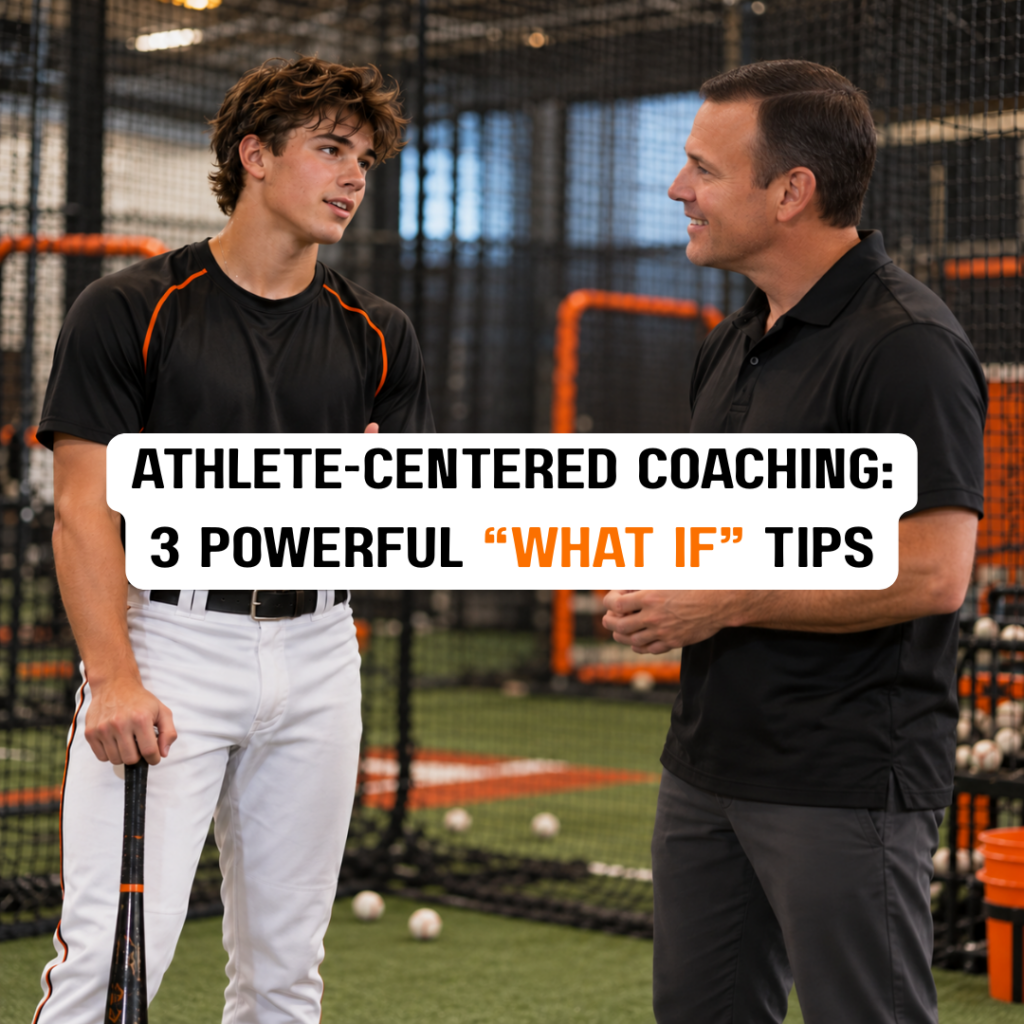
The Power of “What If…?”: Athlete-Centered Coaching That Builds Motivation
As a clinically diagnosed anxiety sufferer, I used to dread two little words: “what if.”
Any question that started that way sent my mind straight to the worst possible outcome. Failure. Embarrassment. Disaster. You name it.
Today, those same two words are one of my favorite coaching tools. They sit at the heart of athlete-centered coaching.
In this post, I’ll share how a surprising source changed the way I think about “what if,” what the research says about motivation in young athletes, and three simple ways parents and coaches can start asking better questions this week.
From Catastrophe to Possibility: Reframing “What If”
For most of my life, “what if” was a trigger.
What if I fail?
What if I embarrass myself?
Every version ended badly.
Several years ago, I finally started to master my anxiety with the help of proper medication and a toolbox of mental skills.
One of the biggest shifts was learning that “what if” can point toward possibilities just as easily as catastrophes.
That shift is the foundation of this post. The same question that once fueled my fear can fuel a young athlete’s growth, if we ask it the right way.
What Professional Wrestling Taught Me About “What If” Questions
I’ll admit it: I’ve been a fan of professional wrestling (yes, WWE) since childhood. I don’t watch nearly as much as I did as a kid. As an adult, though, I’ve become fascinated by how the industry works behind the scenes. Wrestling podcasts are a guilty pleasure of mine.
Those podcasts dig into the creative storytelling process, and one detail stuck with me. When wrestling executives work on creative ideas, they often frame feedback as a question: “What if… we tried it this way?”
That small framing does a lot of work:
- It avoids directly criticizing someone’s idea, which keeps unnecessary conflict out of the room.
- It invites the person who pitched the idea to make it better, instead of defending it.
- It turns feedback into a collaborative process where the possibilities feel endless.
So why bring this up in a blog about youth sports?
Because I believe asking young athletes “what if?” can be a key part of their long-term athletic and personal development. It’s athlete-centered coaching in its simplest form.
What Is Athlete-Centered Coaching?
Athlete-centered coaching is an approach where a coach or parent creates the conditions for athletes to make choices, share their perspective, and own their development. It stands in contrast to relying on commands, rewards, and punishment to get compliance.
I wrote about this a couple of months ago 👉 How does YouTube keep intentional coaches in business?
Researchers often call this autonomy-supportive coaching, and the idea comes from a psychological concept called Self-Determination Theory.
Research suggests that people who feel a sense of autonomy and competence are more likely to experience intrinsic motivation for whatever they’re doing, including sport (Ryan & Deci, 2000).
In plain terms:
- If a young athlete feels in control of their development, they’re more likely to be self-motivated.
- If a young athlete feels they’re getting better, they’re more likely to stick with their sport.
Over the years, those two feelings can be life-changing.
Why Controlling Coaching Styles Backfire
Unfortunately, young athletes don’t always feel in control of their development. Controlling behavior by adults, such as coaches, teachers, or parents, may be one reason why (Moreno-Murcia et al., 2019).
Controlling adults lean on commands, rewards, and threats of punishment to get an athlete to do what they want. In a study of 340 athletes, Moreno-Murcia and colleagues found that a controlling coaching style was linked to greater fear of failure. A supportive, athlete-centered coaching style, on the other hand, was linked to less of it.
When mistakes feel unacceptable, frustration and fear follow.
Mistakes, especially physical mistakes, should be a vehicle for learning, not punishment.
What an athlete learns from a mistake can fuel improvement going forward. And praising what’s controllable, such as effort, attitude, and willingness to improve, usually leads to more sustainable motivation.
How “What If” Questions Support Athlete-Centered Coaching
So how can one small question make a real difference in a young person’s development?
Parents often ask me how to talk with their kids about sports. My answer is almost always the same: ask more questions. Specifically, ask questions that start with “what” and “how.” They let young athletes explain things in their own voice.
Instinctive criticism, or questions that start with “why,” tend to put them on the defensive. I know I get defensive when someone asks me why I did something.
A question like “What if you tried it this way?” creates the conditions for an athlete to feel both autonomy and competence:
- They can embrace the suggestion and see if it works for them.
- They can turn it down and keep doing what they’re doing.
- If the old way keeps producing the same results, they can revisit the suggestion later and adopt it as their own.
No one is forcing them to change or criticizing them for doing it “wrong.” That’s athlete-centered coaching in action.
A Lesson From the Batting Cage
I learned this the hard way during an individual mental performance coaching session with a high school baseball player. It was our first session in the batting cage. I assisted and observed as he worked through hitting drills, and for the first 20 to 30 minutes I said very little.
He was visibly frustrated with his performance. Finally, he slammed his bat down and asked what we were doing, and whether I was going to say anything.
It was one of the most uncomfortable moments I’ve had working with an athlete. My silence, with no explanation, had made him uneasy. I told him I could have done a better job explaining the purpose up front. Still, the information I gathered was priceless. And it sparked a better idea: what if I asked him, “What if…?”
If you coach hitters, my post on how to coach focus of attention in baseball covers another piece of the puzzle.
What the Research Says About Athlete-Centered Coaching
In my view, asking “what if” is a textbook autonomy-supportive behavior. Research on autonomy-supportive teaching describes a student-focused attitude as being curious about what students are thinking and wanting, and open to their input (Reeve & Cheon, 2021).
The same principle sits at the core of athlete-centered coaching.
Better yet, Reeve and Cheon’s work shows that autonomy support is a skill adults can learn, not a fixed personality trait.
Why Telling Is Easier Than Asking
Honestly, it’s often more convenient to just tell a young athlete what to do and how to do it. As a parent, my instinct is usually to give commands rather than ask questions.
It doesn’t help that many young people seem uncomfortable with questions that require them to engage and think critically. When I put the ball in their court, I often get silence, and that makes everyone uncomfortable. (I was trained specifically to use silence constructively.)
Even so, I believe my job as a mental performance coach is to challenge young athletes to think critically and solve their own problems. Creating the conditions for them to own their development is my responsibility. Telling them how to solve their problems isn’t the best long-term answer.
That’s the trade-off at the heart of athlete-centered coaching: short-term convenience versus long-term ownership. Highlighting their strengths, and giving them the chance to use those strengths on their own, gives them the best shot at long-term success. It starts with meeting athletes where they are.
3 Athlete-Centered Coaching Tips for Parents and Coaches
What if… you, as a parent, coach, or teacher, tried one of these three tips this week?
- Ask more questions. Resist the urge to tell a young athlete what they should be doing. Try “What if you tried it this way?” and give them a chance to form their own solutions.
- Put yourself in their shoes. How often has someone at work told you how to do your job? Did you like it? Most young athletes already know what they need to do. Create the conditions for them to do it.
- Focus on their strengths. Instead of fixing their problems, focus on what’s possible when a young person leverages their unique strengths and talents.
Put These Tips Into Practice With a Free 10-Day Challenge
If you want a structured way to help a young athlete build these skills on their own, my free 10-Day Level Up Your Mental Game challenge is a good place to start.
Each day, athletes get a short video, about 1 to 2 minutes long, with one practical mental tool they can use that same day. The tools range from setting process goals and building a reflection habit to a one-breath reset for pressure moments.
The challenge is built for student-athletes ages 14 to 22, and the ownership stays with them: they decide how to apply each day’s tool in their own sport.
That’s athlete-centered coaching in practice. Parents and coaches can share it as a simple starting point and then step back.
Frequently Asked Questions About Athlete-Centered Coaching
What is an example of athlete-centered coaching?
Asking a young athlete “What if you tried it this way?” instead of ordering a change is a simple example. The athlete gets a suggestion plus the freedom to test it, reject it, or come back to it later.
Is athlete-centered coaching the same as autonomy-supportive coaching?
They overlap heavily. Autonomy-supportive coaching is the research term for one core piece of athlete-centered coaching: giving athletes real choices and a voice in their own development.
How is athlete-centered coaching different from a controlling style?
A controlling style relies on commands, rewards, and threats of punishment. An athlete-centered style offers choices, explains the reasons behind suggestions, and invites the athlete’s input. Research links controlling coaching to greater fear of failure in athletes (Moreno-Murcia et al., 2019).
Can parents use athlete-centered coaching too?
Yes. After a game, ask “what” and “how” questions instead of offering critique or asking “why.” It gives young athletes room to reflect in their own words.
Keep the Conversation Going
Want more ideas like this?
Join my newsletter for mental performance tips for athletes, parents, and coaches.
And if you’d like help bringing athlete-centered coaching to your, schedule a free 30-minute consultation now.
References
Moreno-Murcia, J. A., Huéscar Hernández, E., Conte Marín, L., & Núñez, J. L. (2019). Coaches’ motivational style and athletes’ fear of failure. International Journal of Environmental Research and Public Health, 16(9), 1563. https://doi.org/10.3390/ijerph16091563
Reeve, J., & Cheon, S. H. (2021). Autonomy-supportive teaching: Its malleability, benefits, and potential to improve educational practice. Educational Psychologist, 56(1), 54–77. https://doi.org/10.1080/00461520.2021.1862657
Ryan, R. M., & Deci, E. L. (2000). Self-determination theory and the facilitation of intrinsic motivation, social development, and well-being. American Psychologist, 55(1), 68–78. https://doi.org/10.1037/0003-066X.55.1.68