
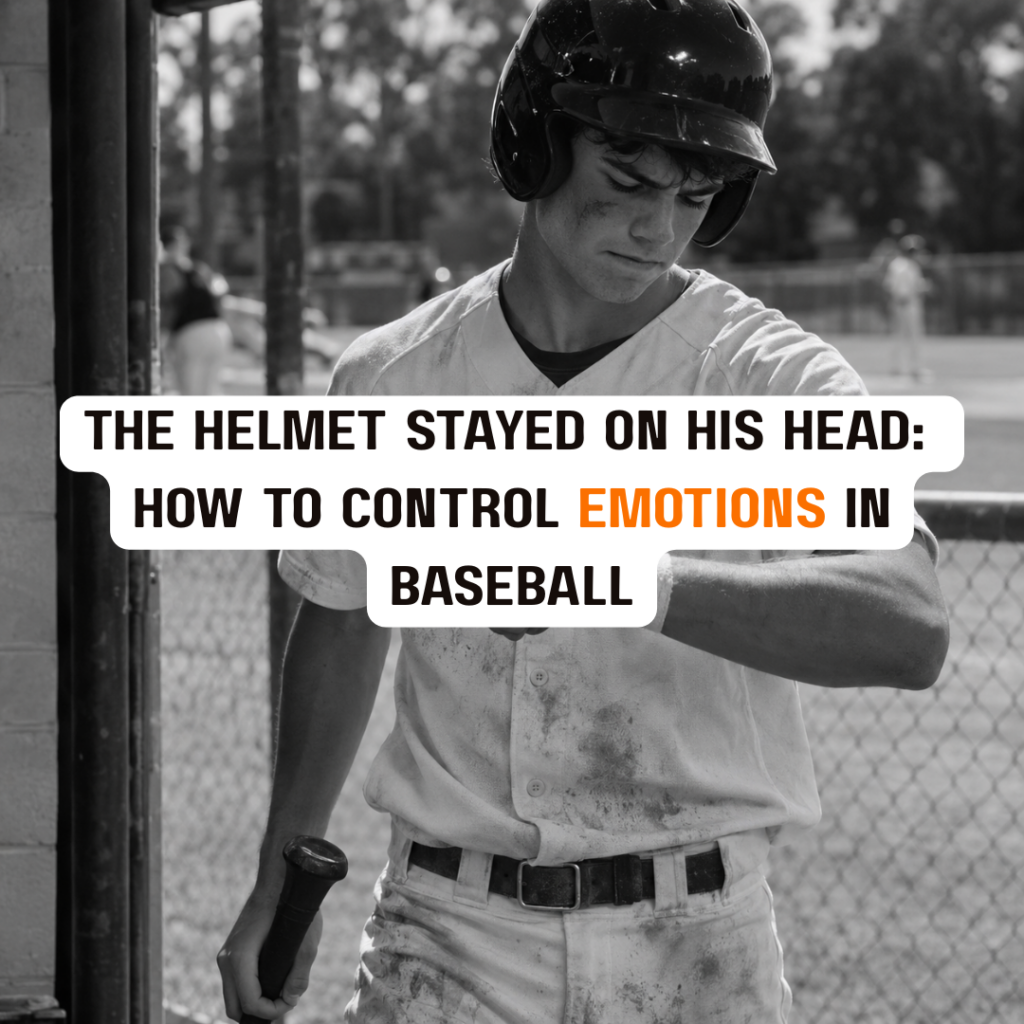
The Helmet Stayed on His Head: How to Control Emotions in Baseball
“You did great up until the last two at-bats.”
That’s what a father told his son on the drive home from a tournament.
His son didn’t want to hear it.
He was 17, a high school senior, and a very good hitter. So good he was headed to play college baseball.
This is the story of how he learned to control emotions in baseball after a strikeout, and the four-step reset routine any young athlete can practice this offseason.
Two strikeouts, one helmet, one bat
He’d hit the ball hard all weekend.
Then came the last game.
The other pitcher didn’t throw hard. 81, maybe 82. But he had a changeup nobody on the team could touch.
First at-bat: two changeups, two swings and misses. Then a fastball he was sure was way outside.
Strike three.
He walked back to the dugout and threw his helmet.
Next at-bat, another strikeout. This time it was his bat.
His father had reached out to me that summer. I still remember what his dad said during our initial consultation: his son’s behavior was embarrassing to their family.
“I don’t really remember exactly what happened”
When we talked after that weekend, I asked him to walk me through both at-bats.
He remembered every pitch of the first one.
The second? “I don’t really remember exactly what happened.”
That told me a lot.
It was all happening in a blur. He wasn’t deciding to throw his helmet. In his words, it was “just like a reaction.”
And he didn’t like it either. “I was a little mad at myself after doing it,” he said. “But I felt like it got the anger out.”
That’s the part a lot of parents miss. Most young athletes who throw equipment aren’t choosing to. The emotion shows up faster than the decision. Learning to control emotions in baseball starts with slowing that moment down just enough to notice it.
Beating yourself vs. getting beat
Then he told me what his hitting coach said about that last strikeout: it was a really good pitch.
“I never thought of it like it was a good pitch,” he said.
There’s a difference between beating yourself and getting beat.
That day, he got beat. So did everyone else on his team.
We talked about what big leaguers like Aaron Judge do after a strikeout. They look up at the scoreboard and walk back to the dugout.
They’re boiling on the inside. They just don’t show it.
That isn’t a lack of emotion. It’s emotional control: feeling the anger without letting it make the next decision. That’s what it looks like to control emotions in baseball at the highest level.
The red button on his wrist tape
So we started building his reset routine. The first step was noticing the anger before it turned into a thrown helmet.
He drew a red button on his wrist tape.
Red, like a stop sign.
A reminder to stop and check his emotions before he reacted.
It didn’t work overnight.
But by the end of his senior season, the helmet stayed on his head.
How to control emotions in baseball: the 4 R’s reset routine
So, what does this have to do with your athlete?
Even great hitters strike out.
The question isn’t whether it happens. It’s what happens next.
The red button was one piece of a four-step reset routine I teach baseball players. I often refer to it as the “4 R’s”:
One: Recognize. Notice the emotion as it shows up. The hot face. The tight grip. The urge to slam something. This is where the red button lives.
Two: Reboot. Take a breath and let the last pitch go. It already happened.
Three: Refocus. Pick the one thing that matters for the next pitch. What’s Important Now.
Four: Resume. Step back in and compete, pitch by pitch.
This isn’t just a coaching hunch. A 2024 systematic review in the Journal of Physical Education found a clear relationship between how athletes regulate their emotions and how they perform in competition.
The good news? Like a swing, the ability to control emotions in baseball can be trained. And the offseason is the best time to train it.
I put the whole routine into a free guide, Spring Training for the Mind. It walks your athlete through each step, with simple ways to practice this offseason. After you sign up, you’ll get one short email for each step over the next four days.
👉 Get the free Spring Training for the Mind guide
One question to ask your athlete this week
Ask your athlete:
“What do you want to look like after a strikeout?”
Then just listen.
And if the next car ride home is quiet, let it be quiet. The at-bats can wait. Helping your athlete control emotions in baseball often starts with giving those emotions some room.
Frequently Asked Questions
How can a baseball player control emotions after a strikeout?
Start with recognition. Most outbursts happen before the player has decided anything. A simple cue, like a red button drawn on wrist tape, reminds him to pause and reset before the next pitch. Practiced over time, the reset becomes the reaction.
Why do young athletes throw helmets or bats?
Usually it’s a reaction, not a choice. Frustration builds and the body releases it. Many players say it “gets the anger out,” but it pulls their focus off the next at-bat and can embarrass them and their team.
What is a reset routine in baseball?
A short, practiced sequence a player uses after a mistake to let go of the last pitch and focus on the next one. The 4 R’s (Recognize, Reboot, Refocus, Resume) is one example.
Should I talk to my athlete about a bad game on the drive home?
Often the best move is to wait. Right after a game, emotions are still running high. One open question later, followed by listening, usually goes further than a review of every at-bat.
When is the best time to learn to control emotions in baseball?
The offseason. Without games every weekend, young athletes have room to practice mental skills before the pressure of the season arrives.
Can mental performance coaching help with anger in sports?
Yes. Many young athletes learn to control emotions in baseball faster with a guide. A mental performance coach helps them understand what triggers their reactions and builds simple tools so they can respond rather than react under pressure.
👉 Schedule a free 30-minute consultation now
Michael Huber holds a master’s degree in sport psychology. He has helped hundreds of young athletes ages 14 to 22 be themselves when everyone is watching, including learning how to navigate overthinking under pressure. Learn more about Michael