

Journaling for Athletes: The 5-Minute Habit I Started (and Kept)
A new notebook. A couple of good pens. Five questions.
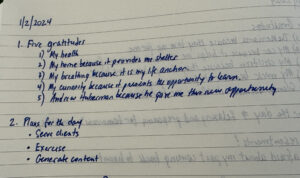
That’s how I started a habit on January 1, 2024. Not because I believe in New Year’s resolutions. I don’t. You can start a new habit whenever you’re ready. But the end of a year tends to bring reflection, and I knew it was time to build better physical, mental and emotional habits.
The habit was journaling, and it’s one I recommend to my clients all the time.
Journaling for athletes isn’t about writing pages of feelings every night. It can take five minutes. Here’s the simple protocol I use, why it works, and how young athletes can make it their own.
Why Journaling for Athletes Works
Journaling has helped me build habits, focus my energy and hold myself accountable. When it comes to journaling for athletes, the biggest benefit is awareness.
When athletes reflect regularly, they learn. They notice what helped them perform and what got in the way. Awareness tends to come before improvement, every time.
There’s more than one way to journal. Long-form writing about emotions has its place. I’ve used it during some of my darkest moments to make sense of what I was thinking and feeling.
But that’s not the style I want to talk about here. I prefer short, prompted journaling. It takes very little time, and it doesn’t require any creativity. You answer the same questions every day, and over time you build a useful record of what matters to you.
The Huberman Journaling Protocol: 5 Daily Prompts
I borrowed this protocol from Stanford neuroscientist Andrew Huberman, host of the Huberman Lab podcast. I respect how much he relies on scientific evidence, and his approach lines up with my own philosophy as a mental performance coach.
In a December 2023 Instagram post, he shared five prompts to answer each morning:
- List five things you are grateful for.
- Write down your plans for the day.
- Name any fears or resentments you have.
- Identify things to watch out for.
- Identify things you want to work toward.
Huberman estimates it takes three to five minutes. I agree. That’s manageable for almost anyone, including a busy high school athlete.
Try it for at least a week. And if it isn’t working for you, stop. Forcing yourself through a practice you dislike just creates one more resentment to write about.
What I Noticed When I Started
I write by hand. I like putting pen to paper more than typing, and a new notebook made the whole thing feel like a small treat.
After the first couple of days, it was too early to judge whether it was working. But I already appreciated the structure it gave my mornings. And one prompt stood out.
Fears and resentments.
I rarely stopped to think about mine. Yet they’re often my biggest obstacles. At times, they’ve paralyzed me. Naming them before the day starts gives me a chance to work around them, push through them, or at least accept that whatever they’re doing to me is temporary.
So what does this have to do with mental performance coaching? A lot.
Many of us feel overwhelmed by our responsibilities and by everything we can’t control. Young athletes feel it too. Tournaments. Showcases. Recruiting worries. Prompted journaling narrows the focus to what matters most today. I’ve seen that simplicity help me, and I’ve seen it help my clients for years. That’s the real value of journaling for athletes.
How Young Athletes Can Use the 5 Prompts
The same five prompts work well as journaling for athletes, with a small shift toward sport:
- Grateful for: a teammate, a coach, a healthy body, the chance to play.
- Plans for the day: practice, lift, film, school. What’s on the schedule?
- Fears or resentments: “I’m worried about the scout being there.” “I’m frustrated about playing time.” Naming them takes away some of their power.
- Things to watch out for: the moment after a mistake, the urge to rush, the voice that says “don’t mess up.”
- Things to work toward: one controllable goal for today, like staying loud on defense or taking a breath before each pitch.
On game days, it’s a quick way to get the mind settled before warm-ups. On practice days, it keeps the focus on getting better instead of getting it perfect.
3 Tips to Get the Most From Journaling for Athletes
One. Don’t overthink it
Trust your first instinct. Perfection isn’t realistic, and chasing it can freeze you up. Write down whatever comes to mind first. It’s usually what matters most to you right now.
Two. Set yourself up for success
Keep your journal where you’ll see it. Pick a consistent time: first thing in the morning, with your coffee, or right after you shower. A planned routine makes it much more likely you’ll stick with it.
Three. Reflect at night
Huberman’s protocol doesn’t include an evening check-in, but I’d add one. Take a minute or two before bed to look back at your day. What did you learn? What matters most tomorrow? That short review closes the loop on the morning prompts.
Journaling for athletes pairs well with other simple confidence tools. If your athlete worries about everyone watching, read my post on the spotlight effect. And for a short weekly dose of mental performance ideas, join my newsletter.
Frequently Asked Questions About Journaling for Athletes
Why is journaling good for athletes?
Journaling builds awareness. Athletes who reflect regularly notice what helps them perform and what gets in the way, which makes it easier to improve and to manage pressure.
What is the Huberman journaling protocol?
It’s a short daily routine Andrew Huberman shared in late 2023. Each morning, you list five things you’re grateful for, your plans for the day, your fears or resentments, things to watch out for, and things you want to work toward.
How long should athletes journal each day?
Journaling for athletes can take as little as three to five minutes a day when you use prompts. Consistency matters more than length, so pick a time you can stick with every day.
Should athletes journal before or after games?
Both can help. A few prompts before a game can settle the mind and set one controllable focus. A short reflection afterward helps athletes learn from the game without dwelling on it.
Is it better to journal by hand or on a phone?
Either works. Many people find that writing by hand slows them down and helps them focus, but the best method is the one you’ll actually keep doing.
👉 Schedule a free 30-minute consultation now
Michael Huber, MA, CMPC® holds a master’s degree in sport psychology. He helps young athletes ages 14 to 22 be themselves when everyone is watching, including learning how to navigate overthinking under pressure. Learn more about Michael