
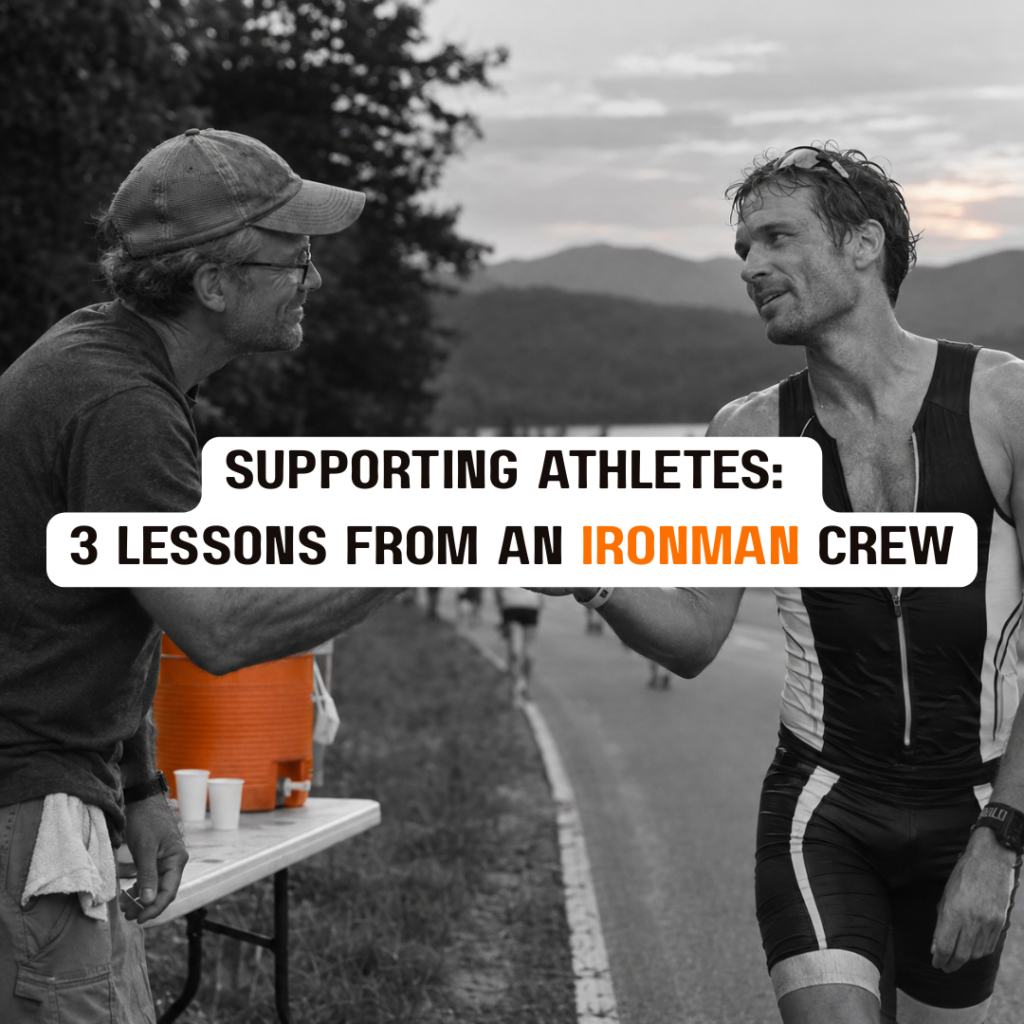
Serving Others, Ironman Edition: What Crewing for Two Friends Taught Me About Supporting Athletes
5:00 a.m. in Lake Placid, New York.
Dark.
Cold.
Two nervous friends in my car.
Mike and Dave were about to race their first Ironman: a 2.4-mile swim, a 112-mile bike, and a 26.2-mile run.
I wasn’t racing.
I was the driver, the ice runner, the guy holding the camera at the transition.
I first wrote about that weekend in 2019, as I was finishing my master’s degree in sport psychology. I’m sharing it again because, years into coaching, it’s still the clearest picture I have of what supporting athletes looks like. The athlete races. The crew serves. And the crew matters more than you might think.
How I Ended Up on the Crew
Mike, Dave, and I are childhood friends.
The October before, the three of us ran the Chicago Marathon together. When they signed up for Ironman Lake Placid, I knew I wasn’t willing to take on that kind of training. I was willing to give them my time and energy.
I’ll be honest. My reasons weren’t purely selfless.
I wanted to support my friends. I also saw the weekend as a chance for some professional development, since I was close to finishing my degree.
Then a friend who had finished his first Ironman the year before suggested supporting athletes during the race as a volunteer. I hadn’t even thought about it.
A quick search turned up a whole page of volunteer roles: crowd control, registration, helping families make signs, handing out food and drinks on the course. I signed up for the run course, in the last time slot on Sunday.
A Long Day on the Other Side of the Rope
Saturday, I helped Mike and Dave haul gear and get ready. Sunday started with that 5:00 a.m. drive to check-in.
I waited at the swim-to-bike transition to cheer them through. Then I ran errands: ice and drinks for after the race. That afternoon, I was back at the bike-to-run transition, where I snapped a photo with Mike as he headed out on the run.
Then I spent three hours at my post on the run course.
Water.
Gatorade.
Chicken broth (yes, chicken broth).
An Ironman takes many athletes 13 to 15 hours. A lot of the people passing my station were in their 11th, 12th, or 13th hour.
They were exhausted.
And still, so many of them looked me in the eye and said thank you for the drink, thank you for volunteering.
The most rewarding part, though, was Mike, Dave, and their families. They thanked me over and over. And in the middle of all the stress of a first Ironman, we found time to laugh.
“I’m Not Jealous That I’m Not Competing”
That spring, my master’s program had asked me to write a detailed philosophy for my coaching practice. The central theme I landed on was helping others through service. Whether I’m supporting athletes or business executives, my intention to improve their performance and their lives matters more than the setting.
That weekend, I wrote one line in my journal: “I must be getting old because I’m not jealous that I’m not competing.”
That line surprised me.
In the past, my ego would have been loud.
You should be out there.
Look at that guy passing you.
Why aren’t you racing?
Some of the quiet was practical. I have an arthritic left hip. Ironman training can take 25 to 30 hours a week. I had just run a marathon. But most of it was something else. I was content supporting athletes rather than trying to beat them.
What the Research Says About Serving Others
My mixed motives that weekend are normal.
Researchers who studied thousands of volunteers in Australia found that people are rarely purely selfless or purely self-interested when they help (Stukas et al., 2016). Most of us help for a blend of reasons: expressing our values, learning, feeling good about ourselves, connecting with others, and building a career. I could check every box.
The same study found that volunteers whose motivation leaned more toward helping others tended to report higher well-being and more satisfaction with the experience than those driven mostly by self-focused reasons.
So, what does handing out chicken broth on an Ironman course have to do with your kid’s travel ball season? A lot.
3 Lessons for Supporting Athletes
Every sports parent is on a crew. So is every spouse, friend, and coach supporting an athlete of any age. Here’s what that day in Lake Placid taught me about doing the job well.
One. You’re the crew, not the competitor. My ego wanted to race. Plenty of parents feel the same pull, and some end up competing through their kids. Ask yourself honestly: whose race is this? Your athlete owns their sport. Your job is to serve it.
Two. Show up for the unglamorous stuff. The 5:00 a.m. drive. The ice. The snacks. The gear. Nobody posts about that work, but it frees your athlete to focus on what’s important now. Supporting athletes is mostly quiet, practical help.
Three. Meet them where they are in hour 12. The athletes passing my station didn’t need a lecture about their pacing. They needed broth, water, and a little encouragement. After a tough game, your athlete probably doesn’t need a breakdown of every mistake on the car ride home. Food, water, and “I love watching you play” go a long way.
This applies to athletes, too. The teammate who cheers from the bench, rebounds for a shooter after practice, or checks in on an injured friend is serving others. That kind of service builds stronger teams, and based on the research, it may make the athlete doing it feel better, too.
The Crew Matters More Than You Think
I went to Lake Placid thinking I’d watch my friends race. I left understanding something about the work I wanted to do.
The athletes in their 12th hour still found the energy to say thank you. Mike and Dave’s families thanked me again and again. Being the one who serves turned out to be its own kind of reward.
That weekend was a small sign that I was moving toward my real role as a coach: focusing on others first. I’m still content with that shift. And I believe sports parents can find the same contentment in supporting athletes, as long as we remember whose race it is.
If you’d like more stories like this one, join my newsletter. And if you’re not sure how to support your athlete right now, reach out. I’m happy to talk.
Frequently Asked Questions
What does supporting athletes look like for parents?
Mostly practical, quiet help: getting them to practice, keeping them fed and rested, and being a calm, encouraging presence. It means letting your athlete own their sport while you handle the support role, the way a crew supports an Ironman racer.
What should I say to my athlete after a tough game?
Often, very little. Offer food and water, let them decompress, and say something simple like “I love watching you play.” Save any talk about performance for later, and let your athlete decide when they’re ready.
Is it okay to want something for myself as a sports parent?
Yes. Mixed motives are normal; research on volunteers shows people rarely help for purely selfless reasons. The key is noticing when your own goals start to outweigh your athlete’s, and stepping back into the crew role.
How can athletes serve their teammates?
Cheer from the bench, help a teammate with extra reps, check in on injured or struggling teammates, and thank coaches and support staff. Small acts of service build team connection.
Does helping others improve well-being?
Research suggests it can. In a large study of volunteers, people whose motivation leaned toward helping others tended to report higher well-being and satisfaction (Stukas et al., 2016).
👉 Schedule a free 30-minute consultation now
Michael Huber, MA, CMPC® holds a master’s degree in sport psychology. He helps young athletes ages 14 to 22 be themselves when everyone is watching, including learning how to navigate overthinking under pressure. Learn more about Michael