
I Forgot The Milk: A Lesson In Mental Performance
I forgot the milk.
I went to the grocery store earlier this week and forgot the milk.
Why?
Because I didn’t bring my grocery list.
I often tell young athletes: If I don’t bring a list, I forget something — guaranteed.
So, what does this have to do with mental performance coaching?
A lot.
What a Grocery List Has to Do With Mental Performance
Because athletes forget too. They forget the strategies we talk about in our sessions — especially in the middle of a game — unless they bring their own version of a “grocery list.”
That’s not a knock on them. It’s hard to remember a plan when the game is moving fast and something just went wrong.
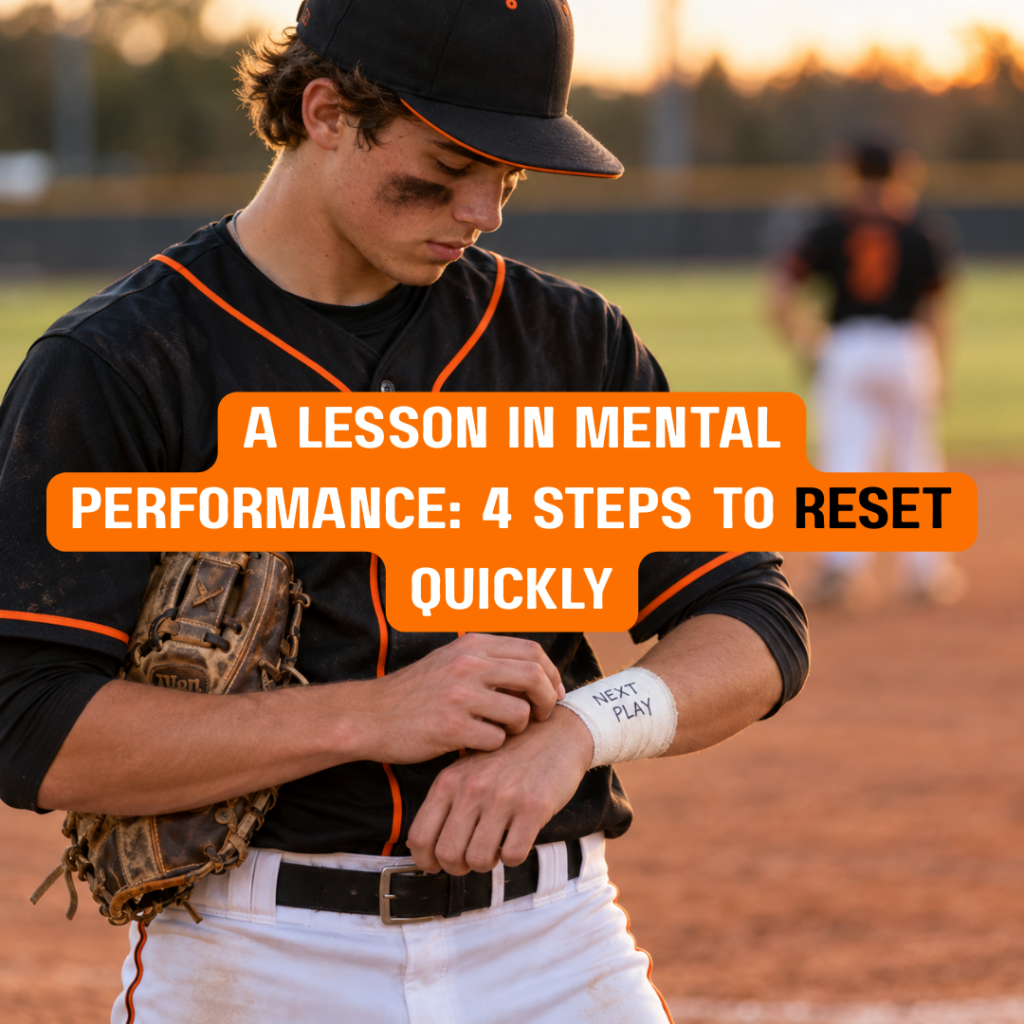
So I often suggest athletes write a word or phrase somewhere they’ll see it during competition. A reminder to refocus. To get back to What’s Important Now — WIN.
The Refocus Cue: A Grocery List for Game Day
They might write it:
On their wrist tape.
On their glove or hand.
Under the bill of their hat.
I’ve seen athletes write things like:
“Team first.”
“Do you.”
“Make an impact.”
These simple cues remind them how to reset after a mistake or distraction.
Just like a grocery list helps me remember the milk, a visual refocus cue helps an athlete remember who they want to be when adversity hits.
Look at what those three phrases have in common.
They’re short. They’re in the athlete’s own words. And they point at something to do, not something to avoid.
“Don’t strike out” isn’t a cue. It’s a worry.
Why Athletes Get Stuck in Their Heads
A little mental performance theory helps here.
Dr. Robert Nideffer, a psychologist, identified two key dimensions of attentional focus: width and direction.
Width refers to how broad or narrow their focus is — like scanning the field (broad) or locking in on a target (narrow).
Direction refers to whether their focus is internal (thoughts, emotions, body) or external (ball, opponent, coach).
Put the two together and you get four kinds of focus:
- Broad and external: reading the field.
- Broad and internal: working out a plan.
- Narrow and internal: rehearsing the next move in their head.
- Narrow and external: eyes on the ball, the target, the next play.
None of the four is bad.
Good mental performance is being in the right one at the right time, and getting back to it when you drift.
After mistakes, athletes often go internal:
What did I do wrong?
What’s wrong with me?
Is Coach going to take me out?
That’s not unusual.
What is problematic is staying there too long.
Because then — what happens?
They make another mistake.
And maybe another after that.
The key is learning how to shift from internal to external focus quickly.
But here’s the challenge: that shift is really hard in the moment — especially when the mistake feels big.
That’s where the grocery list comes in.
A visual reminder helps them interrupt that internal spiral and refocus on what’s next.
How to Refocus After a Mistake: 4 Simple Steps
Here’s how an athlete can build their own mental performance grocery list.
- Pick the words. One word or a short phrase that means something to them. Not to me, not to a parent, not to a coach.
- Put it where their eyes already go. Wrist tape. A glove. The bill of a hat. A water bottle.
- Use it in practice first. A cue that only shows up on game day hasn’t earned any meaning yet. Practice is where it gets it.
- After the mistake: look, read, next play. Eyes on the cue. Read it. Then eyes back out to the ball, the target, a teammate.
That fourth step is the whole point. The cue is the bridge from internal back to external.
Say a shortstop boots a ground ball.
Without a cue, the next pitch finds them still replaying the error. With one, they glance at their wrist tape, read “Next play,” and get their eyes back on the hitter.
It’s a mental performance skill, and it takes reps like any other skill.
Will It Work Every Time?
Nope.
Even with a list, sometimes they’ll still forget the milk. And that’s okay. They’re human — just like me.
But with practice, bringing that mental grocery list to the game becomes second nature.
And focusing on WIN becomes a habit.
Refocus Cue FAQ
What is a refocus cue?
A refocus cue is a mental performance tool: a word or short phrase an athlete writes somewhere they’ll see it during competition. Its job is to pull their attention off the last play and onto the next one.
What does WIN stand for?
What’s Important Now. It’s a question an athlete can ask at any point in a game. The answer is almost never the mistake they just made.
Where should an athlete write their cue?
Anywhere they’ll see it without trying: wrist tape, a glove, the back of a hand, under the bill of a hat. If they have to go looking for it, it’s in the wrong place.
How can a young athlete refocus after a mistake?
By shifting their attention from internal (what went wrong) to external (what’s next). A written cue makes that shift easier because it gives their eyes somewhere to go.
How does a refocus cue fit into mental performance training?
It’s one small piece. Mental performance covers how an athlete handles focus, confidence and pressure. A cue is a tool for the focus part.
Michael Huber, MA, CMPC® holds a master’s degree in sport psychology. He helps young athletes ages 14 to 22 be themselves when everyone is watching, including learning how to navigate overthinking under pressure. Learn more about Michael.
If this post resonated with you 👉Schedule a free 30-minute consultation now