
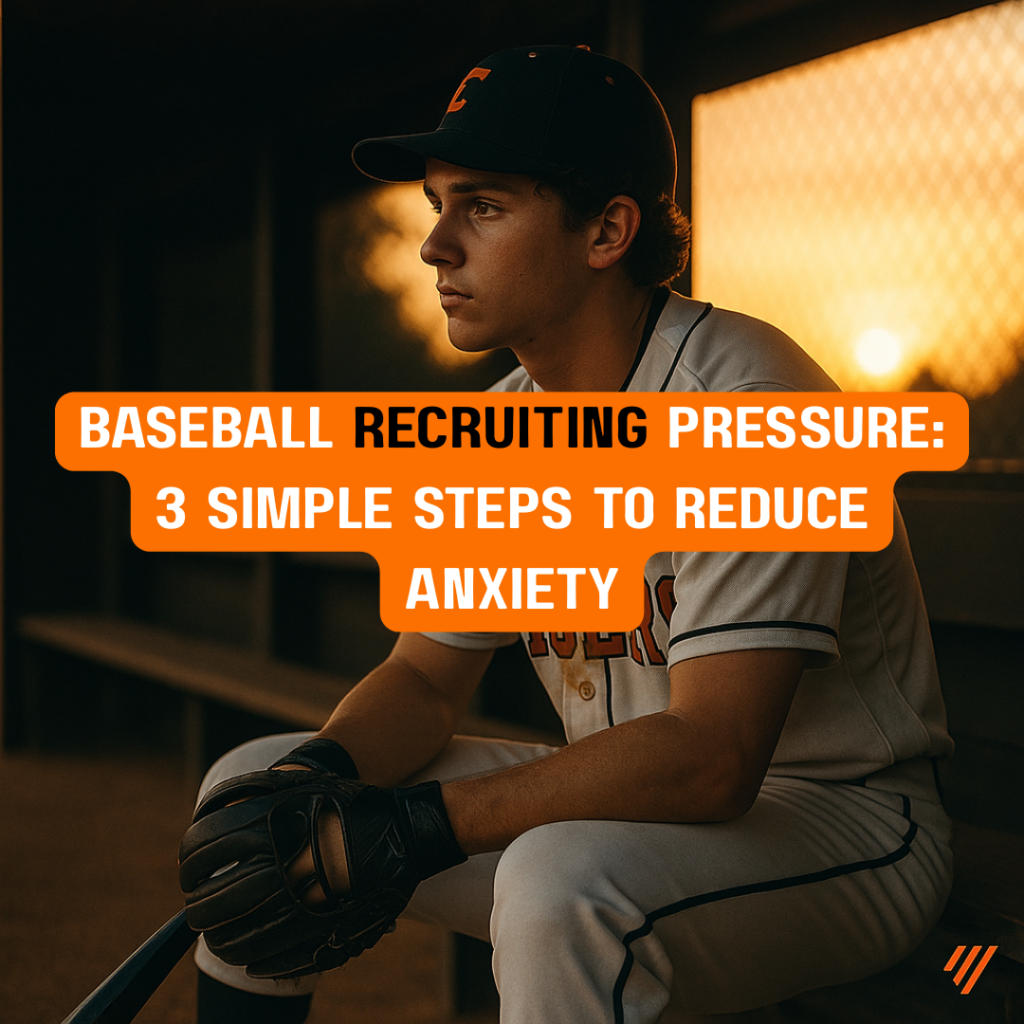
The Reality of Baseball Recruiting Pressure in Summer Ball
“I’m a little bit worried. It’s the start of summer ball. I want to start off strong.”
One of my high school baseball players shared this with me during our regularly scheduled session this week.
He had just finished his high school baseball season after being knocked out in the semifinal playoff round.
However, there wasn’t much time to reflect. He would be hitting the road the following morning for a 7-hour car drive to a showcase at a Division I school.
He used the word “worried” six times in one hour when discussing his summer.
The thought of showcasing at a “Power 4” school was weighing heavy on his mind. That’s baseball recruiting pressure in its purest form.
Summer ball can feel like a make-or-break season for high school baseball players.
Showcases.
Tournaments.
Nonstop recruiting talk and social media feeds.
So much rides on a relatively small number of games.
And the pressure?
It’s very real.
I see baseball recruiting pressure up close with my clients going through the process. The challenges can extend well beyond the field.
They have trouble sleeping.
They are overthinking on and off the field.
They’re not acting or playing like themselves.
It’s hard to watch. And honestly, it’s hard to coach through sometimes, too.
Why Baseball Recruiting Pressure Feels Heavier Today
When I played high school baseball, many years ago, things were simpler.
I wanted to play in college, but I had no idea how recruiting worked. I just assumed coaches would find me if I was good enough. My lack of knowledge was actually a blessing.
I already put enough pressure on myself. I didn’t need the extra layer of “who’s watching?“
Now, players know.
They know when scouts are in the stands.
They know the stakes.
And that awareness often makes baseball recruiting pressure feel bigger and heavier than it already is.
3 Steps to Manage Baseball Recruiting Pressure
When I work with players feeling overwhelmed, I fight the urge to “fix it.” Because the truth is, I can’t fix it.
However, I can help them find a bit more control inside the chaos. This is what I tell players, parents, and coaches (and remind myself).
Here’s how we start:
Step 1: Identify What You Can Control
We make two lists: what they can control, and what they can’t.
It might sound elementary. However, it’s typically much harder than young athletes think.
Separating what they can and can’t control builds mindset-shifting awareness.
They realize they don’t have to carry all of the baseball recruiting pressure, just a few key pieces.
Step 2: Recognize What’s Working (and What’s Not)
We talk about what they’re thinking, feeling, and doing when things go well, and when they don’t.
The goal is further building awareness, not self-flagellation.
Catching unproductive patterns earlier means they can stop them before spiraling.
Step 3: Keep It Simple When It’s Hard
When everything speeds up and the pressure builds, that’s the moment to slow down.
Not by adding something new, but by resetting with one simple act: a deep breath.
It’s definitely not groundbreaking advice.
Yet, most athletes haven’t been told why it matters, or how it works.
I explain how the brain interprets baseball recruiting pressure as a threat.
College coaches watching?
That’s a danger signal to the nervous system.
Heart rate rises.
Muscles tighten.
Breathing becomes shallow.
And then… things fall apart.
But a deep breath sends the opposite message:
“I’m safe.”
“I’m okay.”
“I can handle this.”
With that breath, they shift focus back to something productive, something they’ve trained.
What Progress Looks Like Under Baseball Recruiting Pressure
Progress doesn’t always look like you think. My clients remind me of this.
One player has told me he usually overthinks 80% of the time. After a few sessions, it was down to 60%. Not a stat anyone else would notice, but for him, huge progress.
Another had a rough first outing after we started working together. Control wasn’t there yet. But his body language? His attitude? Positive. He bounced back faster. His mother said, “There were glimmers of the player we know.”
And one player, at a big showcase in Georgia, had a great week: a .467 average, over .500 on-base, and eight RBIs. But what he was most proud of?
Staying focused on his breath and his simple mantra: “See ball. Hit ball.”
That’s what handling baseball recruiting pressure really looks like. Not a perfect week, but a player who knows how to come back to what he’s trained.
The Mental Game Isn’t Magic. It’s a Practice.
We’re not chasing perfection.
We’re building trust: trust in the process, in preparation, and in the knowledge that when baseball recruiting pressure hits, there’s something to lean on.
Confidence doesn’t come from being perfect.
It comes from knowing what to do when things aren’t.
What Mental Performance Coaching for Baseball Recruiting Pressure Looks Like
Before we wrapped, I asked him to tell me his plan for the weekend showcase.
Here are my notes that capture what he shared with me:

FAQ: Baseball Recruiting Pressure
What is baseball recruiting pressure?
Baseball recruiting pressure is the stress high school players feel when they know college coaches and scouts may be evaluating them. It often peaks during summer showcases and tournaments, when a small number of games can feel like they decide a player’s future.
How does baseball recruiting pressure affect players?
It can show up both on and off the field. Common signs include trouble sleeping, overthinking, worrying about who’s in the stands, and not playing like themselves. Physically, the nervous system treats the pressure as a threat, which can raise heart rate, tighten muscles, and make breathing shallow.
How can players handle pressure at a baseball showcase?
Start with three simple steps. First, separate what you can control from what you can’t. Second, notice what you’re thinking, feeling, and doing when things go well and when they don’t. Third, when the moment speeds up, reset with one deep breath and return your focus to something you’ve trained.
How can parents help with baseball recruiting pressure?
Parents can help by keeping the focus on what their player controls, like effort, preparation, and attitude, rather than who’s watching. Recognizing small wins, like bouncing back faster after a tough outing, also helps players see progress that box scores don’t show.
Michael Huber holds a master’s degree in sport psychology and works as a mental performance coach, helping young athletes build the confidence and mental skills that complement their physical training. Learn more about him.
If this post hit home, let’s talk to see if I can help 👉 BOOK A CALL