
Be Yourself Under Pressure: 3 Powerful Truths
Two nights before one of the biggest interviews of her life, a high school senior sat across from me and shut down.
Her story is the clearest example I know of why it matters to be yourself under pressure, and why polishing a “perfect” version of yourself so often backfires.
Be Yourself Under Pressure: A Conversation Before a Life-Changing Interview
I recently worked with a high school senior, whom we’ll call Maya, two nights before her Princeton admissions interview.
Maya was a four-year starter on her varsity basketball team, and for much of that time she was all in on playing in college.
By senior year, she had walked away from that goal entirely. It wasn’t because she couldn’t play. She didn’t want to settle academically just to keep playing.
She was weighing schools she’d never heard of, in places she’d never been, against the most elite academic institutions in the country:
The Ivy League.
Stanford,
Notre Dame.
Her focus was neuroscience, and someday, neurosurgery.
She was applying to Princeton.
Then, two nights before her Princeton interview, Maya went quiet. She was distracted and off.
On the surface, it looked like basketball: a new coach, bad team chemistry, and a season she no longer had a reason to care about. Underneath it, I think she was scared.
So we shifted the conversation.
We talked about why Princeton. Not the brand name, but the actual mission.
Serving something bigger.
A learning community, not a big city.
Adding value, not just being admitted as an achievement.
Then her mom’s voice came up. “You blink a lot.“
Her mom meant well, but it was one more thing to fix, perform, and manage.
I told Maya that if Princeton says no because she blinks too much, that’s not her school. My only advice was to be yourself under pressure. Nothing else required.
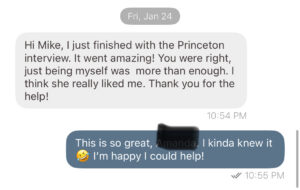
Seven hours later, a text came through:
“Hi Mike, I just finished the Princeton interview. It went amazing. You were right. Just being myself was more than enough. I think she really liked me. Thank you for the help.“
I wrote back: “This is so great. I kinda knew it. I’m happy I could help.“
So, what does a college interview have to do with mental performance coaching?
Everything.
What It Looks Like to Be Yourself Under Pressure
Maya walked into that room carrying two versions of herself. One was polished and managed, watching her own blink rate. The other was just… her.
The work we did wasn’t interview prep.
It was permission. Permission to stop performing a version of herself she thought Princeton wanted, and to trust the version that got her the interview in the first place.
That is what it looks like to be yourself under pressure.
It isn’t unique to the college admissions process.
It’s true when walking into a tryout. It’s true when stepping into the batter’s box. And it’s true anytime a young person believes who they really are isn’t enough, so they perform an edited version instead.
Controlling the controllables is mental skills 101.
You can’t control whether someone likes you.
You can control whether you show up as yourself.
3 Truths About How to Be Yourself Under Pressure
Here are three truths about performing under pressure, whether in an interview, in a game, or anywhere else.
1. Trying to Be “Impressive” and Trying to Be Yourself Are Two Different Strategies
Performing a version of yourself works, sometimes. But it’s exhausting, and it’s fragile. Only one of these strategies is sustainable.
The version of you that shows up naturally is the only one you can access under real pressure. That’s why the ability to be yourself under pressure matters more than any polished delivery.
2. Nitpicking Symptoms Misses the Real Lever
Blinking, fidgeting, tone: these are symptoms, not the source. Confidence isn’t fixed by managing tics.
It’s built by knowing who you are and why you’re there before you walk into the room.
3. “I Think You’re Going to Kill It, Whatever That Means” Is a Complete Sentence
Sometimes the most helpful thing you can offer a young person isn’t a strategy. It’s belief, stated plainly, with no conditions attached. Belief like that makes it easier to be yourself under pressure, because there’s nothing left to prove.
A Dad’s Perspective: Is It Worth It?
I’m living this one right now, as a dad, not a coach.
My daughter, a high school junior, has seriously considered playing college soccer for at least a year. She’s been making lists, sending emails, and playing year-round. But she’s hitting a wall. The process is slow, and feedback is limited at this juncture.
Schools are interested in her for soccer, but not necessarily the type she wants to attend in a perfect world.
Her academic performance could reasonably allow her to apply to the same types of schools as Maya. However, the schools interested in her for soccer are in remote areas with small enrollments and average academic reputations.
The question Maya had to answer is the same one my daughter will have to answer eventually: Is it worth it?
My goal as her father is to help her understand her values clearly enough that she can make her decision with the clarity Maya had.
1 Challenge to Help Your Kid Be Themselves Under Pressure
The next time your kid is about to walk into something big, like a tryout, an interview, or a hard conversation, resist the urge to coach them on their delivery.
Instead, ask them one question: “What do you actually want them to know about you?”
Then let that be enough. That single question gives a young person a clear reason to be yourself under pressure, rather than a list of things to fix.
Frequently Asked Questions
What does it mean to be yourself under pressure?
It means showing up in a high-stakes moment as the person who earned the opportunity in the first place, rather than as an edited, over-managed version of yourself. To be yourself under pressure is to trust your values, your preparation, and your natural way of communicating.
Why is it so hard to be yourself under pressure?
When the stakes feel high, many young people believe who they really are isn’t enough, so they perform the version they think others want. It feels safer, but it’s exhausting and fragile, and it makes it harder to be yourself under pressure at the exact moment it matters most.
How can parents help a teen before an interview, tryout, or big game?
Resist the urge to coach their delivery or point out tics. Instead, ask what they actually want the other person to know about them, and express belief plainly with no conditions attached. Clarity about who they are and why they’re there is the real source of confidence.
Can a mental performance coach help a young athlete be themselves in high-stakes moments?
Yes. Mental performance coaching helps young athletes clarify their values, focus on what they can control, and build the confidence to be yourself under pressure, whether that’s at a tryout, in the batter’s box, or in a college admissions interview.
Michael Huber holds a master’s degree in sport psychology and works as a mental performance coach, helping young athletes build the confidence and mental skills that complement their physical training. Learn more now.
WANT TO HELP YOUR YOUNG ATHLETE SHOW UP AS THEIR BEST SELF WHEN IT MATTERS? 👉 Schedule a free 30-minute consultation now