
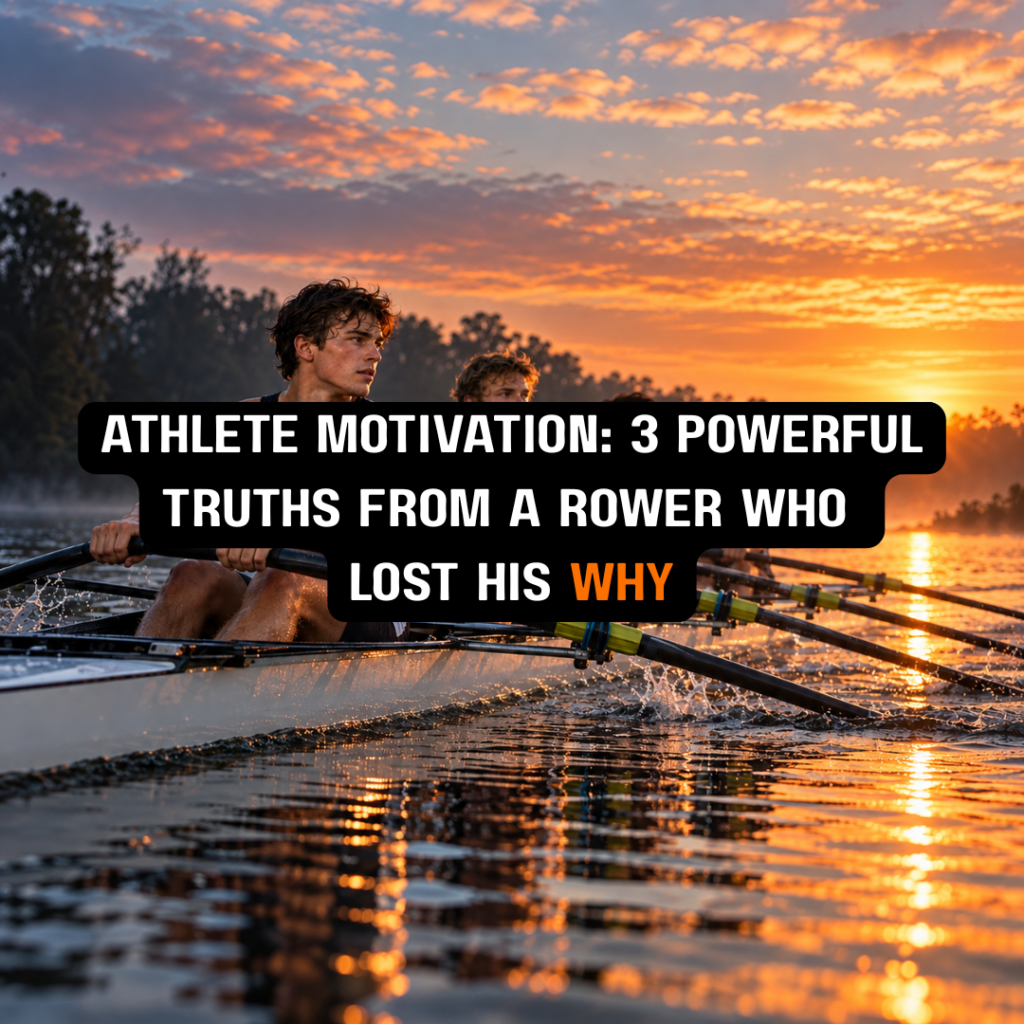
A Rower Who Forgot His Why: A Story of Athlete Motivation
I first met Steven in early 2022.
He was a high school freshman, swimming competitively, following in his mom’s footsteps as a former collegiate swimmer.
Then his motivation started to fade.
He started questioning everything. Was swimming even the right sport for him? He wondered about rowing instead, his dad’s sport.
By 2023, he’d made the switch. His mom emailed me one word that said it all:
“He’s thriving.”
He was thriving enough to catch the attention of Ivy League crew programs. We got to work preparing him for college interviews: his why, his values, his curiosity.
Everything was tracking.
When Athlete Motivation Hits a Wall
Then, April 2024.
Another email from his mom. Things had changed.
Injuries.
A performance plateau.
Momentum?
Gone.
Steven was chasing a Nationals qualifying spot, the goal he’d had since day one of rowing. Now it was in jeopardy.
We got back to work, and I asked a lot of questions.
What surfaced wasn’t a technique problem. It was a purpose problem.
Steven had lost his why.
So, what does losing your “why” have to do with athlete motivation and mental performance coaching?
Everything.
What Losing Athlete Motivation Actually Looks Like
Rowing is brutal.
Early mornings. Painful repetition. Physical and mental exhaustion.
If you don’t know exactly why you’re doing it, it’s easy to want to quit. That’s exactly where Steven was, and it’s where athlete motivation breaks down for a lot of young athletes.
So we went back to basics:
What do you enjoy about rowing?
What can you do differently to improve?
What’s in your control to increase your chances of qualifying?
I asked him to shrink his focus from the whole season down to 24-hour windows.
What’s my goal for today?
What action moves me closer to it?
Small wins, stacked daily.
Not the whole mountain, just the next step.
That shift mattered.
Soon after, Steven’s coaches invited him into a newly formed “Open 4” boat: no coxswain, unfamiliar territory, not the plan he’d imagined.
He didn’t complain.
He attacked it.
The boat improved. So did he.
His confidence, focus, and effort all sharpened.
They qualified for Nationals.
They didn’t race as well as they’d hoped. But Steven came home with something more valuable than a result: a rebuilt sense of purpose, renewed athlete motivation, and a plan for his senior year.
At the team’s end-of-year banquet, Steven was named team captain.
Where Sustainable Athlete Motivation Comes From
There’s a theory in sport psychology called Self-Determination Theory. It says humans stay motivated when three basic needs are met:
Autonomy: a sense of control over your own choices.
Competence: a sense that you’re actually getting better at something.
Relatedness: a sense of connection to other people in the pursuit.
Take any one of those away, and athlete motivation starts to erode.
Steven had all three factors challenged at once. His schedule wasn’t his own, with early mornings dictated by the boat. His results had plateaued, so he had no sense of progress. And he was isolated in his own head, stuck on outcomes instead of connected to his team.
That’s when we rebuilt, one piece at a time.
Daily controllable goals gave him back autonomy, something he could decide and act on every single day.
Stacking small wins gave him back competence, visible proof he was improving even before the results caught up.
And the Open 4 boat gave him back relatedness: a new crew, a shared challenge, people in it with him.
All three needs, restored.
That’s not a coincidence. That’s the mechanism behind lasting athlete motivation.
3 Truths About Athlete Motivation: Losing (and Finding) Your Why
Here are three truths about athlete motivation, purpose, and getting unstuck.
1. The cause of a slump is rarely obvious.
When performance stalls, the instinct is to fix the mechanics.
Sometimes the real issue is upstream. The athlete has lost autonomy, competence, or relatedness, and the results are just the symptom.
2. Shrinking your focus rebuilds competence faster than chasing outcomes does.
Steven didn’t get unstuck by thinking bigger. He got unstuck by thinking smaller: one day, one controllable action, one small win at a time. That’s competence, rebuilt in real time.
3. The unplanned opportunity is sometimes the one that restores relatedness.
The Open 4 boat wasn’t the plan. It became the turning point: a new crew, a shared challenge, and the connection Steven didn’t know he was missing.
1 Athlete Motivation Challenge
Ask your athlete one question this week: “What do you love about your sport?”
Then listen to the answer without judgment.
If the answer is results-oriented, it might be something to keep an eye on. Athlete motivation built only on outcomes tends to crack when the outcomes stop coming.
Frequently Asked Questions About Athlete Motivation
What causes athlete motivation to drop?
According to Self-Determination Theory, athlete motivation drops when one or more basic needs go unmet: autonomy (control over choices), competence (a sense of improvement), or relatedness (connection to others). Injuries, plateaus, and isolation often challenge all three at once.
How can parents help improve athlete motivation?
Start by asking what your athlete enjoys about their sport, and listen without judgment. Help them focus on daily, controllable goals rather than season-long outcomes, and encourage connection with teammates.
Is a lack of athlete motivation a sign my child should quit their sport?
Not necessarily. A dip in athlete motivation is often a purpose problem, not a sport problem. Steven switched from swimming to rowing, but later, when his motivation faded again, rebuilding his why kept him in rowing and led him to Nationals.
Can a mental performance coach help with athlete motivation?
Yes. A mental performance coach helps athletes identify what’s really driving a slump, reconnect with their why, and build daily habits that restore autonomy, competence, and relatedness.
***
Michael Huber holds a master’s degree in sport psychology and works as a mental performance coach, helping young athletes build the confidence and mental skills that complement their physical training. Learn more now.
WANT TO HELP YOUR YOUNG ATHLETE SHOW UP AS THEIR BEST SELF WHEN IT MATTERS? 👉 Schedule a free 30-minute consultation now