
When Overthinking Under Pressure Takes Over at the Plate
“When the lights come on, that’s when I start to lose it.”
That’s what a second-year college outfielder told me this week. We’ll call him Nate.
In batting practice, he’s loose. Smoking balls off the fence.
In the outfield, no worries at all.
Then the scrimmage starts.
Same coach throwing.
Same pitches.
Different hitter.
Tight shoulders. Jammed by fastballs he should crush. Swinging at pitches over his head.
He’s checked everything.
His mobility.
His mechanics.
His load.
The voice in his head sounds like this:
“No, it’s mental. No, it’s physical. No, it’s mental. No, it’s physical.”
That loop is what overthinking under pressure sounds like from the inside.
(Does this sound familiar? Let’s talk.)
Competing Against an Old Version of Himself
Then he told me what’s underneath it.
Two years ago, as a high school senior, he was the best hitter he’s ever been. The ball looked slow. He didn’t think. He just hit.
Now he watches those old videos on his phone.
And when he steps into the box, a quiet voice tells him he’s not that guy anymore.
He isn’t competing against the pitcher.
He’s competing against an 18-year-old version of himself.
Why “Don’t Think” Makes Overthinking Under Pressure Worse
Everyone gives him the same advice.
“Don’t think. See the ball, hit the ball.”
He’s tried. It makes him feel worse.
“Is there something wrong with me?”
NO.
You’re human. You can’t just stop thoughts from entering your mind.
Overthinking under pressure is not a character flaw. It is a mind doing its job without any direction.
The One Thing Behind His Best Swings
So I asked a different question.
When you’ve taken your best swings, what was going on?
He started listing them.
A 400-foot home run. He was thinking about his hands bouncing.
A double off the fence. He was thinking about getting his butt back before the pitch.
His best scrimmage last fall. Same cue.
Then he heard himself say it.
“There’s always just been ONE thing.”
(I wish I could’ve found that one simple thing back in high school.)
I asked if he was doing any of that now.
“No.”
So that became the plan.
Pick one thing and use it on every pitch.
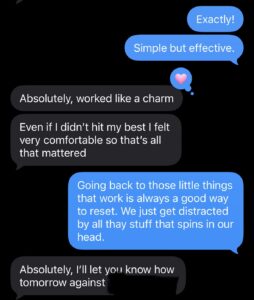
The next day, a text came through:
“Literally, only thought about bouncing my hands in BP today, and it was the most confident I’ve felt at the plate in so long.”
I wrote back:
“I love it. So what happens now?”
“Stick with that same process and ZONE IN on it.”
Then came the line that told me something had changed:
“Even if I didn’t hit my best, I felt very comfortable, so that’s all that mattered.”
My Own Story of Overthinking Under Pressure
So, what does bouncing your hands have to do with mental performance coaching?
A lot.
I’ve been there.
My senior year of high school, I was hitting .500 early in the season.
It felt so easy. My first game I hit a grand slam. The ball looked like a balloon.
I assumed it would stay that way.
Then I hit an 0-for-20 skid.
I panicked.
I had to hit rock bottom before I stopped giving a you-know-what. It let me play again.
That’s not a plan.
It’s not how I want any athlete to get through overthinking under pressure.
It’s a big reason why I do this work.
What Actually Changed in 24 Hours
Nate didn’t fix his swing in 24 hours.
Nothing about his mechanics changed overnight.
What changed was where his attention went.
On his best days, his mind wasn’t blank.
He was thinking about one thing on purpose.
(Here’s a resource to find that one thing…)
When he doesn’t pick it, his mind picks for him.
And his mind picks worry.
The old videos.
Earning a spot.
The hitter he used to be.
Picking worry is what our mind is designed to do, so we need to account for it.
One small cue gave his mind a job.
And look at how he measured the day.
Not by how hard he hit the ball.
By how he felt in the box.
A day earlier, a bad round meant something was wrong with him.
3 Truths About Overthinking Under Pressure
1. “Don’t think” isn’t a strategy.
You’re going to think about something. The only choice is whether you pick it or your brain does. Overthinking under pressure gets louder when an athlete tries to fight it.
2. One small, controllable cue beats a conversation in your head.
Planning a response ahead of time gives an anxious mind somewhere to go. For Nate, that cue was bouncing his hands.
3. Measure the day by the process.
“Even if I didn’t hit my best” is the sound of an athlete defining success by something he controls. Results go up and down. Sticking with one cue is available on every pitch.
1 Challenge for This Week
Before the next practice or game, ask your athlete:
“What’s the one thing you’re going to focus on today?”
Afterward, skip “How’d you do?”
Ask: “Did you stick with it?”
The day after that text, Nate faced a Division I team.
By his own measure, though, the box score isn’t the point.
Frequently Asked Questions About Overthinking Under Pressure
What causes overthinking under pressure?
Overthinking under pressure happens when the stakes go up and the mind has no clear job. It fills the gap with worry: past performances, earning a spot, what a bad result might mean. Nate’s mind went to old videos of the hitter he used to be.
Why doesn’t “don’t think” stop overthinking under pressure?
Because no one can stop thoughts from entering their mind. Trying to go blank usually makes an athlete feel worse, and it leaves the mind free to pick worry. Choosing one thought on purpose works better than trying to have none.
How can an athlete stop overthinking under pressure?
Start by looking back at their best performances and asking what they were focused on. Most athletes find one small, controllable cue. Then they use that cue on every pitch, rep, or play, and judge the day by whether they stuck with it.
How can parents help an athlete who is overthinking under pressure?
Change the questions. Before a practice or game, ask, “What’s the one thing you’re going to focus on today?” Afterward, ask, “Did you stick with it?” instead of “How’d you do?” That shifts the conversation from results to process.
If this post resonated with you 👉Schedule a free 30-minute consultation now
***
Michael Huber, MA, CMPC® holds a master’s degree in sport psychology. He helps young athletes ages 14 to 22 be themselves when everyone is watching, including learning how to navigate overthinking under pressure. Learn more about Michael.