
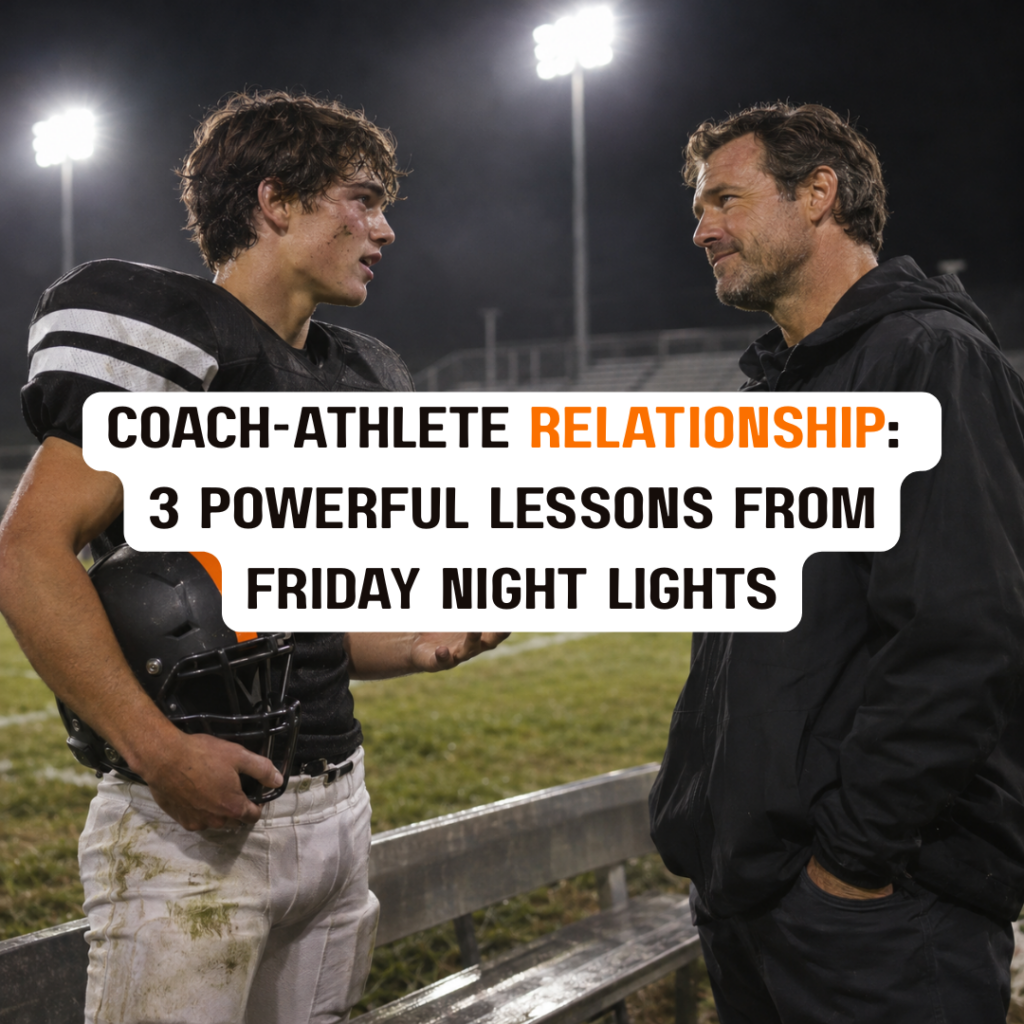
Coach-Athlete Relationship: 3 Powerful Lessons From Friday Night Lights
“Sixty percent.”
That’s how much of his identity one high school athlete told me was wrapped up in being an athlete. The other 40 percent had to cover everything else. Son. Sibling. Student. Partner.
He’s not alone. And the person with the most influence over how that 60 percent feels on any given day? Often, it’s his coach.
As a mental performance coach working with high school and college athletes, I hear about the coach-athlete relationship constantly. Young athletes struggle with it for all kinds of reasons, and it can drag down their performance. Strangely enough, one of the best examples I know of getting it right comes from a TV show.
Why Coach Taylor Is My Favorite Example of the Coach-Athlete Relationship
I don’t watch much TV. When I do, I usually rewatch shows I already love. (I know. Boring. I own it.)
Friday Night Lights is one of them. The critically acclaimed series follows a small Texas town that revolves around its high school football team. The characters are complex. The themes are complex. And it’s just plain entertaining.
The main character, Coach Eric Taylor, is flawed but revered in the fictional town of Dillon, Texas. Part of that is his winning. More of it is the respect his players have for his genuine interest in making their lives better.
Coach Taylor badly wants to win state championships. But his moral compass always brings him back to people over results. That’s the heart of a healthy coach-athlete relationship.
When Youth Sports Put Results Over People
Unfortunately, youth sports in America have become so professionalized that young athletes often get treated like chess pieces.
Much of the system is pay-to-play. Winning has always mattered in sports. It mattered to me as an athlete. It’s human nature.
But at every level, coaches seem to be putting results over people, whether they mean to or not. In my view, that has led to underdeveloped athletes and rising perfectionism in young people.
How the Coach-Athlete Relationship Shapes Perfectionism
Researchers describe perfectionism as a personality trait that pairs very high performance standards with a tendency toward overly harsh self-evaluation (Madigan et al., 2019).
Perfectionism in sport may run hotter than in other parts of life. My sense is that’s because so much of a young person’s identity is wrapped up in their sport. Remember that 60 percent.
I see some level of perfectionism in almost every athlete I work with. It’s more of a continuum than a yes-or-no. The human brain is wired to spot threats, and a mistake can feel like a threat to who you are.
Still, I believe elevated perfectionism in young athletes is largely learned in the athletic environment. The research points the same way. In a study of junior athletes ages 16 to 19, coach pressure to be perfect predicted increases in perfectionism over time, while parental pressure did not (Madigan et al., 2019).
That matches what I see as a mental performance coach and as a youth coach. Pressure to perform often comes from coaches whose own fortunes depend on wins and losses (Mageau & Vallerand, 2003).
Here’s the irony. Coaches who pile on pressure are probably setting young athletes up to perform below their best.
What Effective Coaches Do Differently
Athletes who are well motivated tend to perform better, and coaches have a direct influence on that motivation. So, what do the best coaches do?
They build self-determined motivation. That means the athlete either enjoys the sport for its own sake or plays because they value what it brings to their life (for example, “working hard in my sport will help me in life”).
Coaches who build a strong coach-athlete relationship tend to:
- Offer choices, with structure around them.
- Explain why, instead of just giving orders.
- Show interest in how their athletes feel.
- Try to understand athletes as people outside of sport.
- Give feedback rooted in long-term development, not criticism for a short-term fix.
That first point ties back to structure. I wrote more about it in Demanding Coaching: 3 Powerful Ways to Give Young Athletes Structure.
The Coach-Athlete Relationship Is a Two-Way Street
Coaches often get criticized for a win-at-all-costs mindset. But let’s be clear. The coach-athlete relationship is a two-way street (Mageau & Vallerand, 2003).
We usually expect coaches to own the relationship. Athletes have to own their part, too.
I talked about this with Michigan State University Head Baseball Coach Jake Boss on The Freshman Foundation Podcast. Part of a coach’s job is teaching athletes to take ownership of their athletic careers.
I go out of my way to help young athletes build empathy for their coaches. Coaches get paid to win. Coaches have families to feed. Coaches have career goals. Coaches are responsible for a lot of people.
If the coach-athlete relationship isn’t what you want, advocate for yourself to build it. As Coach Boss pointed out, it’s tough to ask young athletes to put themselves in a coach’s shoes. But it’s worth the effort.
Still, I believe most of the burden falls on the grown-ups. Great coaching goes far beyond wins and losses.
3 Lessons From Coach Taylor for a Stronger Coach-Athlete Relationship
Let’s be clear. Coach Taylor is very human. Wins and losses matter to him. He can be harsh. He yells. He punishes players. He often doesn’t explain his decisions right away.
But he holds himself accountable for his mistakes. And in the end, he puts his players’ well-being ahead of results on the field.
Here are three lessons coaches can borrow from him.
One. Apologize. Coach Taylor is tough and expects a lot. But when he’s wrong, he says so. He models the accountability he wants from his players.
Two. Trust. Coach Taylor takes suggestions from players when he knows it’s best for the team, whether that’s a personnel decision or a play call. Giving players room to speak, and respecting what they say, builds a strong two-way coach-athlete relationship.
Three. Care. Over many fictional seasons, Coach Taylor shows up at players’ homes to deal with issues far beyond the field. Family trouble. Help with recruiting. Or just showing up to apologize for a poor choice.
What else can coaches do to strengthen the coach-athlete relationship with young athletes? I’d love to hear your thoughts.
References
Madigan, D. J., Curran, T., Stoeber, J., Hill, A. P., Smith, M. M., & Passfield, L. (2019). Development of perfectionism in junior athletes: A three-sample study of coach and parental pressure. Journal of Sport and Exercise Psychology, 41(3), 167–175. https://doi.org/10.1123/jsep.2018-0287
Mageau, G. A., & Vallerand, R. J. (2003). The coach–athlete relationship: A motivational model. Journal of Sports Sciences, 21(11), 883–904. https://doi.org/10.1080/0264041031000140374
Frequently Asked Questions
What is the coach-athlete relationship?
The coach-athlete relationship is the ongoing connection between a coach and an athlete, built on trust, respect, and communication. Its quality shapes an athlete’s motivation, enjoyment, and performance.
Why is the coach-athlete relationship important?
Coaches strongly influence athlete motivation. When young athletes feel supported and understood, they’re more likely to enjoy their sport, stay motivated, and perform their best.
Can coaches cause perfectionism in young athletes?
They can play a major role. In one study of junior athletes, coach pressure to be perfect predicted increases in perfectionism over time.
How can athletes improve their relationship with their coach?
Start with empathy. Coaches juggle pressure to win, their own families, and many players. Then advocate for yourself: ask questions, ask for feedback, and communicate respectfully.
What can coaches learn from Coach Taylor in Friday Night Lights?
Apologize when you’re wrong, trust your players’ input, and care about them as people beyond the field. Those habits build a strong coach-athlete relationship.
👉 Schedule a free 30-minute consultation now
Michael Huber, MA, CMPC® holds a master’s degree in sport psychology. He helps young athletes ages 14 to 22 be themselves when everyone is watching, including learning how to navigate overthinking under pressure. Learn more about Michael
Hi! Someone in my Myspace group shared this site with us so I came to check it out. I’m definitely loving the information. I’m bookmarking and will be tweeting this to my followers! Outstanding blog and terrific design.
Использование приложений OTT. Кино фильмы смотреть бесплатно в хорошем качестве.
Онлайн Торрент Телевидение online
TV channel.
Cмотрите онлайн ток-шоу и русские сериалы в HD.
Видео-фильмы из категории для просмотра online..
Тут смотреть онлайн в хорошем качестве бесплатно фильмы.
2022, Россия. Смотреть онлайн.
Кино и сериалы. Буду смотреть..
Хотя филм.
Смотрите фильмы для всей семьи в лучшем онлайн-сервисе
президент україни
what happened in bucha
Вышка
Смотрите фильмы онлайн на вашем iPad.
Фильм Фільм Бетмен (2022) онлайн українською мовою в HD.
Смотреть фильм онлайн бесплатно в хорошем качестве.
Психолог онлайн. Консультация Психолога онлайн – 5348 врачей, 3974
отзывов.
stat
stat
Ukraine
фильм онлайн бесплатно
смотреть онлайн фильмы сейчас
сериалы онлайн сваты
602
руторг фильмы смотреть онлайн
Лучше звоните Солу 9 серия смотреть онлайн бесплатно
Мир Дикого Запада 4 сезон 4 серия смотреть онлайн
пацаны 3 сезон 4 смотреть онлайн бесплатно