
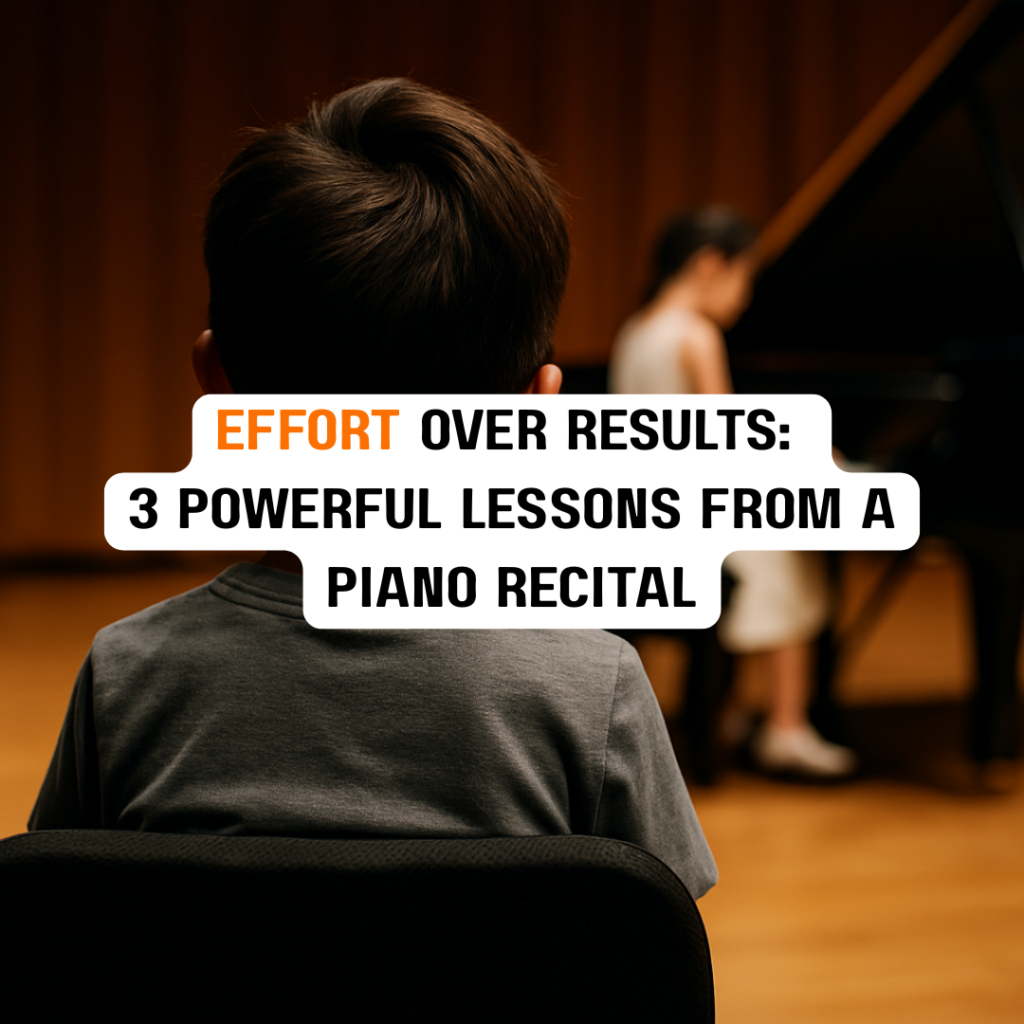
The Part of Performance We NEVER See: Why Effort Over Results Matters for Young Athletes
I went to a youth piano recital today.
One of my best friends invited me to watch his two daughters, 12 and 8, perform.
I left thinking about effort over results, and about how little of a young performer’s work the rest of us ever get to see.
A Youth Piano Recital in Jersey City
The recital was held in a quaint but professional space inside a performing arts center in Jersey City, just in the shadows of Manhattan.
They faced a single grand piano under warm stage lights. It felt intimate in that unique way recital rooms do — quiet, but full of anticipation.
I was curious to experience something new. My children weren’t musicians.
A dozen young pianists sat in the front row, feet tapping, music books shuffling as they waited for their turn.
One by one, each child made the short walk to the piano. They took a bow, accepted encouraging applause, sat at the bench, and placed their small fingers onto the keys.
Some feet didn’t even reach the floor.
With their instructor beside them, they began to play.
They played with 50 adults watching from the stadium-style seating above, and a handful of phones recording.
Smooth Pieces, Choppy Pieces, and Brave Ones
Some pieces were smooth and practiced.
Others were choppy — the kind of careful, searching melodies where fingers feel their way across the keys and eyes dart between the sheet music and their hands.
And somewhere between the missed notes and the brave ones, I shifted from supportive “Uncle Mike” to curious mental performance coach.
And professionally, something became very clear to me:
Not a single performance revealed even a fraction of the work that led to that moment.
The Unseen Work Behind Every Performance
The audience heard only a few minutes of sound from each young pianist.
We didn’t hear the hours of practice in quiet houses after school.
We didn’t hear the mistakes, the frustration, the do-overs, or the tiny breakthroughs.
We didn’t hear the self-doubt they faced before walking onto that well-lit stage.
But the kids felt all of it — and they showed up anyway.
We only witnessed a sliver of the journey they’ve invested in.
Why Effort Over Results Matters in Youth Sports
Sitting there, listening, I found myself thinking about the young athletes I coach.
How often do we, as adults, judge only what we see?
The swing.
The shot.
The result.
Just like a piano recital, those moments are only the surface layer.
Beneath them are hours of unseen effort that deserve just as much, if not more, applause.
Research backs this up. In a well-known set of studies, Mueller and Dweck (1998) found that children praised for effort kept trying longer after a setback than children praised for being smart, and they enjoyed the task more.
Valuing effort over results isn’t about ignoring the scoreboard. It’s about noticing what the scoreboard can’t show.
The Hardest Part Is Being Seen
Because for a young person, the hardest part isn’t playing the piano or stepping into the batter’s box.
The hardest part is letting themselves be seen — letting their work be judged, even when they know it won’t be perfect.
Today reminded me that courage rarely sounds perfect.
Sometimes it sounds like a hesitant melody played by an 8-year-old whose feet don’t touch the floor.
And yet… that might be the purest sound of all.
3 Ways Parents and Coaches Can Put Effort Over Results
1. Name the work, not just the outcome
After a game or a recital, point to something they did to prepare. “I could tell you’ve been working on that” lands differently than “great job.”
2. Notice the courage to show up
Walking to the plate or the piano bench with people watching takes nerve. Say so, especially on the days the result doesn’t go their way.
3. Save the result talk for later
Let the moment settle before you review what happened. Leading with effort over results first keeps the conversation about growth instead of judgment.
For more on handling what happens after a rough moment, read recovering from mistakes under pressure. And if you’re a parent watching from the stands, trusting the process in sports covers the weight that comes with it.
Frequently Asked Questions
What does effort over results mean for young athletes?
It means valuing the preparation, practice and courage behind a performance, not only the final score or stat line. Results still matter, but they aren’t the only thing worth recognizing.
How should I praise my child after a game or performance?
Be specific about what they did: the extra practice, the way they stayed composed, or the decision to try something new. Specific praise for effort tends to build persistence.
Why do kids get nervous performing in front of people?
Performing means being seen and judged in real time. Even well-prepared kids feel that pressure, which is why showing up anyway is worth recognizing.
A Question for Parents and Coaches
If you’re raising or coaching a young athlete, maybe the next time you watch them perform, ask yourself this:
Can you find gratitude for their willingness to take emotional risks and let themselves be seen without judging the results?
Gratitude is one of the 10 mental skills I introduce in my FREE 10-day Level Up Your Mental Game Challenge.
***
Michael Huber, MA, CMPC® holds a master’s degree in sport psychology. He helps young athletes ages 14 to 22 be themselves when everyone is watching, including learning how to navigate overthinking under pressure. Learn more about Michael.