
When Trusting the Process in Sports Gets Hard: A College Baseball Transition Story
“Find someone who knows what they’re talking about and cares about what they do.”
That’s what the father of a college baseball player said to me on Thursday morning.
The implication was that I check those boxes, which is humbling — especially coming from someone who runs a sports academy and coaches for a living.
But the comment wasn’t really about me.
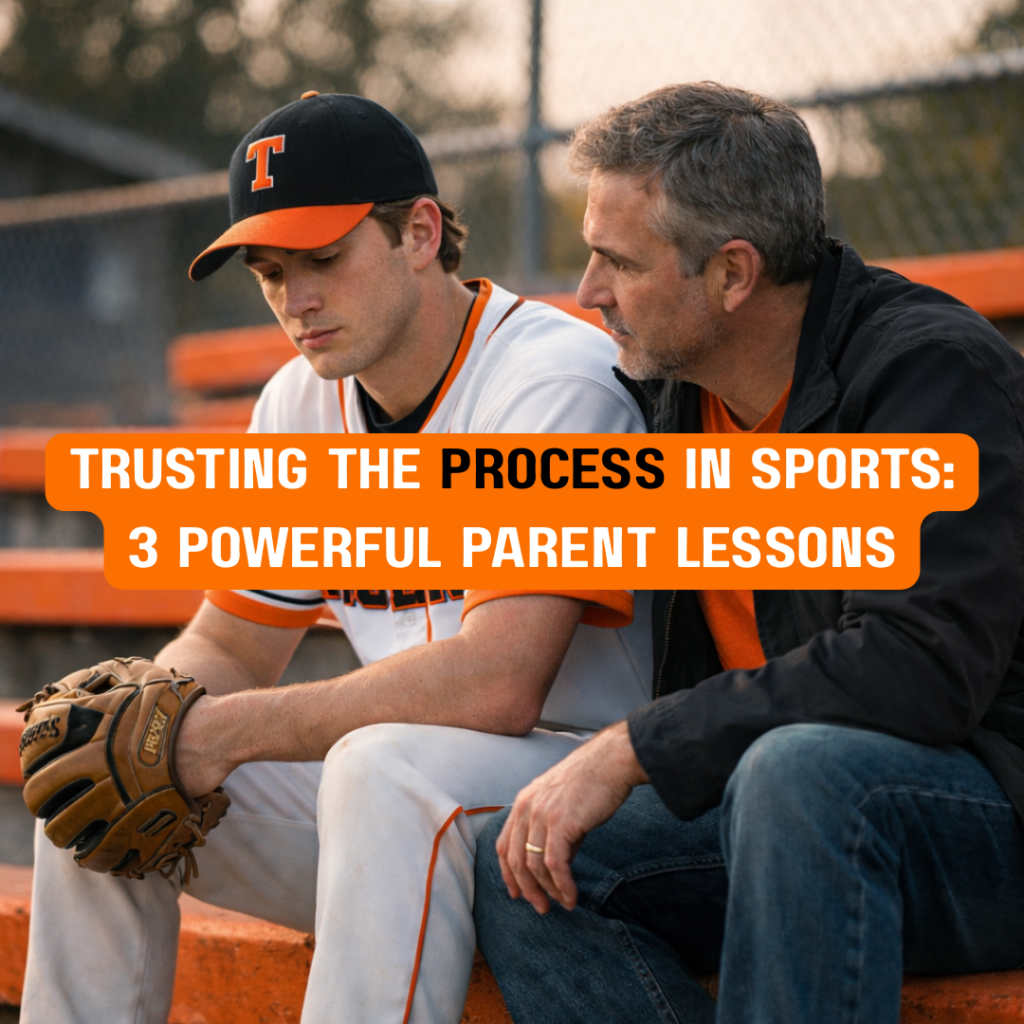
It was about where he finds himself as a parent right now: trusting the process in sports while his son works through his first year of college baseball.
The Fall Exit Interview That Didn’t Bring Clarity
We spent an hour discussing his son’s college baseball transition.
More specifically, we talked about his fall exit interview — a conversation he and his son hoped would bring clarity, but instead left them sitting with more uncertainty.
Nothing went “wrong.”
There was no blow-up.
No harsh criticism.
No dramatic turning point.
He just didn’t hear what he expected to hear.
And afterward, that familiar weight showed up.
Separating Emotion From Information
Initially, the athlete was confused and angry.
Eventually, he processed the conversation and reframed it.
He was able to separate emotion from information and talk through the experience without spiraling.
In fact, it’s helped him focus his efforts on improvement during winter break.
And yet, his father still noticed moments during winter workouts where his son struggled to manage his emotions in live at-bats.
This was the part his father was most concerned about — not what was said in that meeting, but what his son would carry forward from it.
One Conversation Is Not an Identity
He wants his son to be resilient — to manage emotional moments on the field.
Most importantly, he wants to make sure that one conversation, one season, or one stretch of adversity doesn’t quietly turn into a story about who he is as a player.
That concern is well founded.
Researchers who study first-year college athletes describe the jump from high school standout to the bottom of a depth chart as a real hit to confidence and identity. A 2026 study in the Journal of Intercollegiate Sport also points out that a transition is a process, not a single moment — and that honest communication and support make it easier to move through.
From here, our work shifts toward using experiences like this to inform how he responds when things don’t go his way this spring — so frustration becomes something he can learn from, without letting it define him.
If you want to see what that looks like in a game, I wrote about recovering from mistakes under pressure after one college pitcher’s first outing.
Why Trusting the Process in Sports Is Hard for Parents
This father isn’t searching for shortcuts.
He believes in the process.
He respects his son’s independence and values that his son has a place to talk things through objectively — without needing to perform, defend, or impress.
And yet…
Doing the right thing doesn’t make the weight disappear.
This is often where trusting the process in sports gets hard for parents.
You can trust the process.
You can support without hovering.
You can choose patience over urgency.
And still carry a lot.
What a College Baseball Transition Really Tests
College transitions have a way of exposing that tension — not because something is broken, but because something new is being built.
Confidence isn’t removed; it’s recalibrated.
Independence isn’t granted all at once; it’s tested in moments like these.
Sometimes the most meaningful support isn’t about fixing anything.
It’s about having the right people around who can hold the complexity without rushing it away.
3 Ways Parents Can Keep Trusting the Process in Sports
1. Let your athlete separate emotion from information
After a tough meeting, the first reaction is rarely the useful one.
Give it time. Then ask what your athlete heard — not how he feels about the coach.
The goal is to find the information he can actually use.
2. Don’t let one moment become the whole story
One exit interview, one slump, or one bad at-bat is information. It’s not a verdict.
When you hear “I’m just not good enough here,” reflect it back as a moment, not an identity.
3. Support without fixing
Your job isn’t to solve it.
It’s to make sure your athlete has the right people around — a parent, a coach, someone outside the program — who can listen without an agenda.
That’s what trusting the process in sports looks like from the stands.
Same Themes, One Year Later
Almost exactly one year ago, I wrote about working with two other first-year college baseball players navigating similar transitions. Different athletes, different paths — but many of the same themes showed up.
👉 Progress vs. Perfection: Navigating the Transition to College Baseball
Frequently Asked Questions
What does trusting the process in sports mean for parents?
It means supporting your athlete’s long-term development without reacting to every result. You stay patient, let them own their experience, and make sure they have people to talk to.
How can I help my son through his first year of college baseball?
Listen more than you advise. Help him separate emotion from information after hard conversations, and remind him that one season doesn’t define him as a player.
What should an athlete do after a disappointing exit interview?
Let the emotion settle first. Then write down what the coach actually said, pick one or two things to work on, and talk it through with someone objective.
Not Certainty. Support.
That’s what I heard underneath that opening sentence.
Not feeling certainty.
Feeling supported.
If your athlete is going through a college transition and could use a place to talk it through, reach out here. For more stories like this one, join my newsletter.
***
Michael Huber, MA, CMPC® holds a master’s degree in sport psychology. He helps young athletes ages 14 to 22 be themselves when everyone is watching, including learning how to navigate overthinking under pressure. Learn more about Michael.