

Why Mental Performance Coaching Starts With Listening
This young man did something no other athlete had done before—he reached out to me directly. Usually, it’s the parents who initiate contact about my services, but the fact that he took the initiative showed his motivation to improve.
We had our initial consultation last Sunday. We spoke for about 40 minutes—longer than a typical consultation. He shared his struggles with the pressure he was putting on himself and the resulting negative thoughts. I mostly listened, wanting to understand him better before determining if we were a good fit to work together.
Listening is not the warm-up for the real work.
It is the real work.
A young athlete under pressure hears plenty of advice from coaches, parents, and teammates.
What he rarely gets is someone who lets him finish the thought.
When an athlete says the pressure out loud, he hears it for himself. And I learn what is going on before I suggest anything.
(If your athlete puts that kind of pressure on themselves, read my post on overthinking under pressure.)
One Simple Tool: Control What You Can, Accept the Rest
When I did offer advice, it was simple: focus on controlling what you can and accept whatever happens. He told me the idea of acceptance stuck with him, and I was glad to hear it. Acceptance is a critical mental tool, but one that many young athletes struggle to embrace.
Why is acceptance so hard?
Because it can sound like giving up.
It isn’t.
A wrestler can control his preparation, his effort, and his attitude when he steps on the mat.
He can’t control his opponent, the referee, or the final score.
Acceptance means giving full effort to the former and making peace with the latter.
Controlling the controllables is often the first idea I share in mental performance coaching because an athlete can use it the same day.
Three days later, I received a late-night text from him after his first match since our conversation. Here’s what it said:

Reframing Senior Night: From a Test to a Celebration
When we met again, I learned that he was preparing for his Senior Night match — the last home wrestling match of his career. This was a big moment for him, and he wanted a successful outcome.
My approach remained simple. I encouraged him to double down on what had worked in his previous match rather than overcomplicating things. Additionally, I urged him to reframe the meaning of Senior Night. Instead of seeing it as a high-stakes test of his entire career, what if he viewed it as a celebration of all he had accomplished?
He had won over 100 matches in high school and worked relentlessly to earn this moment.
The match itself didn’t change.
Same mat.
Same crowd.
Same stakes.
What changed was the meaning he gave it.
A test is something you can fail.
A celebration is something you get to enjoy.
A reframe like that can take pressure off without lowering an athlete’s standards.
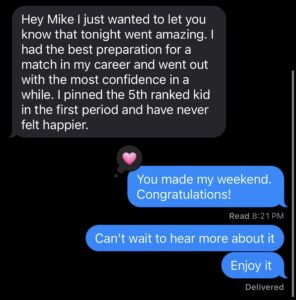
He embraced this mindset shift. After his Senior Night match, he sent me another text, sharing his excitement over his performance. Here’s what it said:
The 3 Simple Secrets to Mental Performance Coaching Success
Was it my “genius” coaching that led to his success?
Hardly. I hope you sense the sarcasm in that question.
I didn’t share anything groundbreaking in those two meetings. I simply listened, helped him shift his perspective, and pointed him in the right direction. He was the one who sought help, made the changes, and executed when it mattered.
This experience reinforced a fundamental truth in mental performance coaching: humility, open-mindedness, and a willingness to change are often the secret ingredients to success.
Here is how each one showed up.
1. Humility
He asked for help.
That isn’t easy for a senior with more than 100 wins.
Saying “I’m struggling with this” is the first step, and no parent or coach can take it for an athlete.
2. Open-mindedness
The idea of acceptance stuck with him.
He could have brushed it off.
Instead, he took it into a match three days later.
3. A willingness to change
He acted on what we talked about.
He doubled down on what worked, and he chose to see Senior Night differently.
An idea only helps when an athlete uses it in competition.
What Mental Performance Coaching Can and Can’t Do
My role is to support athletes in their journey, but ultimately, they do the heavy lifting. Moving forward, my job will be to help him stay consistent in his mental approach—because consistency is where long-term success is built.
Two good matches are a start, not a finish line.
The skills that helped him need repetition:
Focus on what you can control.
Accept what you can’t.
Decide what a big moment means before you step into it.
(For more on what consistency looks like, read my post on decision-making in sports.)
These skills are not only for the mat. Mental performance coaching also translates to life beyond sports.
If you are a parent, the takeaway is simple.
A mental performance coach can’t want it for your athlete.
However, a mental performance can give a young athlete someone who listens, introduce simple, but effective tools, and a clear plan for staying consistent.
Frequently Asked Questions About Mental Performance Coaching
What is mental performance coaching?
Mental performance coaching helps athletes build the mental skills that support performance, like focus, confidence, and handling pressure. It is skill training, much like strength work or technique work in their sport.
How quickly can mental performance coaching work?
It varies. This wrestler took one idea into a match three days after our first conversation. That speed came from his motivation and his willingness to try something different. Lasting change comes from practicing the same skills consistently.
Does my athlete have to want mental performance coaching for it to work?
It makes a big difference. This wrestler reached out on his own, which showed his motivation to improve. Humility, open-mindedness, and a willingness to change have to come from the athlete. A parent can open the door, but the athlete has to walk through it.
What does acceptance mean in mental performance coaching?
Acceptance means giving full effort to what you can control and making peace with what you can’t, like an opponent, an official, or the final score. It isn’t giving up. It lets an athlete compete without carrying the result into every moment.
Did this story resonate? 👉 Schedule a free 30-minute consultation
Michael Huber is a Certified Mental Performance Consultant® with a Master’s Degree in Sport Psychology. My mission is to help athletes ages 14 to 22 be themselves when everyone is watching. Learn more about me.