
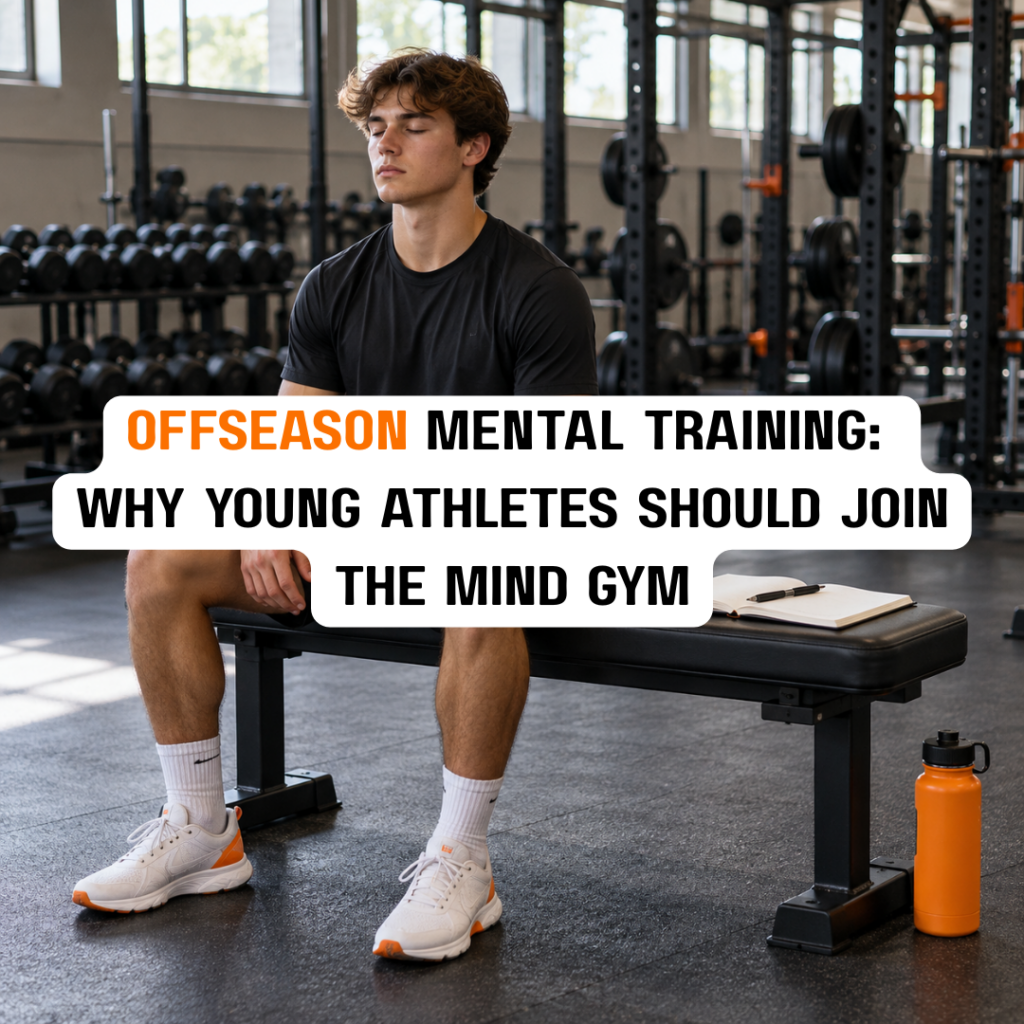
“Too often, sport psychologists are asked to ‘fix’ struggling athletes.”
That line from a 2008 study by Holliday and colleagues sums up a lot of my work as a mental performance coach.
It’s also why I believe in offseason mental training.
The offseason is the best time for a young athlete to build a stronger mental game, and most athletes skip it.
Here’s why it matters, and the 3 steps I use to get started.
Why Waiting for a Crisis Doesn’t Work
Parents often reach out when their athlete is already struggling. A big tournament is coming, confidence is low, and they want help fast.
I’m always glad to help. But I set expectations from the start, with two points:
- There is no silver bullet. Mental challenges usually build over years, and the work takes both of us, coach and athlete.
- Proactive beats reactive. Building skills before you need them works better than scrambling to fix problems in the middle of a season.
That’s where offseason mental training comes in.
Young Athletes Train Their Bodies, Not Their Minds
Think about how a serious young athlete spends the offseason.
Lifting.
Speed work.
Skills sessions.
Now think about how much time goes into mental training. For most athletes, the answer is none.
Yet the mental side is often what separates a good practice player from a good game player.
The offseason, when there’s less pressure and more time, is the ideal window to close that gap.
What Is Offseason Mental Training?
Strength coaches use a concept called periodization: training is planned in phases, and each phase has its own focus. Holliday and colleagues applied the same idea to mental skills. A National Strength and Conditioning Association article on combining physical and mental training explains their main point: the offseason is the best time to teach new mental skills.
In that “prep” phase, athletes spend roughly 8 to 12 weeks learning tools like goal-setting, self-talk, and imagery. Then they practice and sharpen those tools as the season gets closer.
Elite programs can get complex. Young athletes don’t need that. For high school and college athletes, I keep offseason mental training simple, built on 3 steps.
3 Steps to Start Offseason Mental Training
Step 1: Reflect on Last Season
Before you plan where you’re going, look at where you’ve been. I ask athletes to write their answers to a few questions:
- What went well last season?
- What do I want to keep doing?
- What do I want to let go of?
- Where do I most want to improve?
Writing it down matters. It turns a vague feeling about the season into something you can work with.
Step 2: Set Goals You Control
Next, set short-term goals for the offseason, usually the next 2 to 3 months.
Focus on goals you control: effort, preparation, routines, and how you respond to mistakes. Outcomes like wins, stats, and playing time depend partly on things outside your control.
Here’s why that matters. A team can go a whole season without a win, and an athlete can still have a successful season if they met the goals they controlled.
Step 3: Practice Mindfulness 5 Minutes a Day
Of all the mental skills I teach, mindfulness is the most important. It builds present-moment awareness: noticing what’s happening right now instead of replaying the last play or worrying about the next one.
That awareness is what lets an athlete reset in a stressful moment.
To start, find a quiet spot and practice for 5 minutes a day with an app like Headspace or Insight Timer. It’s simple, but it isn’t easy. Focus on showing up every day, not on doing it “right.”
Know Your “Why”
Offseason mental training takes commitment, so it helps to know why you’re doing it.
Maybe you want more confidence.
Maybe you want to stop overthinking.
Maybe you want to play in college.
Only you can answer this question.
Write your answer down and come back to it when motivation dips.
3 Benefits of Offseason Mental Training
- You take control of your mental game. You can’t control every thought, but you can control how you respond to it.
- You gain an edge. Most young athletes don’t train their minds in the offseason. The ones who do stand out.
- You’re ready for next season. You’ll walk into the season with skills you didn’t have before, already practiced and ready to use.
In short: if you think well, you’ll feel well. If you feel well, you’ll perform well.
What Sports Parents Can Do This Offseason
You don’t need to become your athlete’s mental coach to support offseason mental training. A few small steps help:
- Ask reflection questions. Use the 4 questions above at the end of the season, then listen more than you talk.
- Praise what they control. Notice effort and preparation, not just results.
- Make room for mental reps. Five quiet minutes a day is easier with a family routine around it.
- Start before the pressure does. The best time to build mental skills is when nothing is on the line.
Overthinking is one of the most common things athletes bring to me. I share 3 ways to beat it in Decision-Making in Sports.
And to see how the same work helped two families, read how mental performance coaching brought two hockey families peace of mind.
Frequently Asked Questions
What is offseason mental training?
Offseason mental training is a planned period, usually 8 to 12 weeks after the season ends, when athletes learn mental skills like reflection, goal-setting, and mindfulness. It’s the mental version of offseason strength and conditioning.
When should my athlete start?
As soon as the season ends and they’ve had a short break. The offseason is different for every sport, so the right time is whenever the pressure of competition is off.
How much time does it take?
Less than most people expect. Five minutes of mindfulness a day, plus some time to reflect and set goals, is a strong start.
What’s the best way to get started with offseason mental training?
If your athlete wants to use this offseason to build a stronger mental game, I’ve put together a free “Level Up Mental Game Challenge” that’s a great place to get started. It’s 10 days, 10 new mental skills, one short video each day (2 mins or less). It will help your athlete experiment and see what sticks.
***
Michael Huber, MA, CMPC® holds a master’s degree in sport psychology. He helps young athletes ages 14 to 22 be themselves when everyone is watching, including learning how to navigate overthinking under pressure. Learn more about Michael
***
References
Holliday, B., Burton, D., Freigang, D., Hammermeister, J., Naylor, S., & Sun, G. (2008). Building the better mental training mousetrap: Is periodization a more systematic approach to promoting performance excellence? Journal of Applied Sport Psychology, 20, 199-219.