
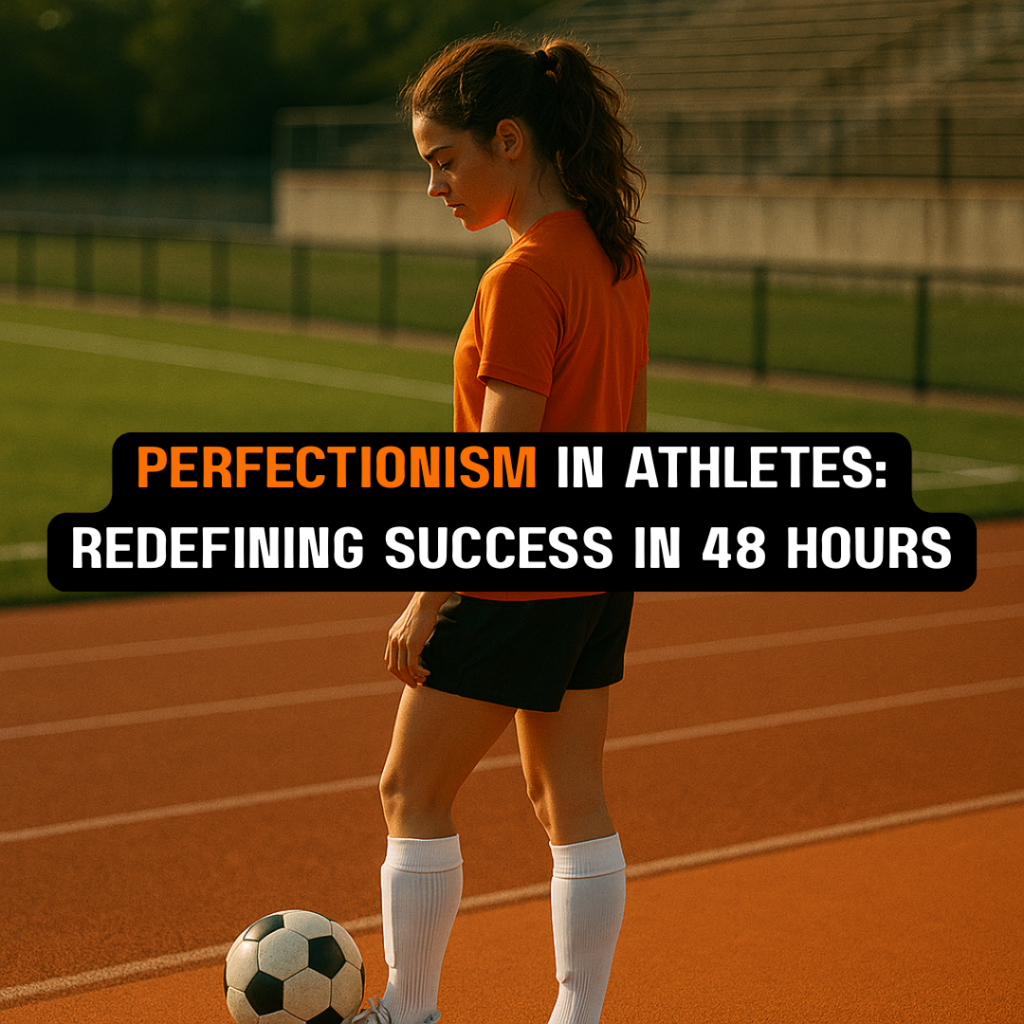
“If I can pass the fitness test, then I can prove I’m a good player…”
That’s what my client Anna told me 48 hours before she had to run the infamous “Beep Test,” a brutal measure of endurance that can make or break a college soccer player’s season.
Or, in Anna’s case, her career.
Anna had spent the past year battling back from a torn ACL. Now, just weeks before the start of her senior season, she wasn’t sure her body, or her mind, was ready.
What she was really up against is something I see all the time: perfectionism in athletes.
As a mental performance coach, I have the privilege of walking alongside athletes through their biggest challenges. But there are moments, like this one, that remind me of something humbling:
No matter how much I help an athlete prepare, I can’t control the outcome.
What I can do is help them take control of the moment.
Anna’s Story
The Comeback No One Sees
Anna is a Division I soccer player I’ve known for years. But I only began working with her in the spring of 2024, when she was at a low point.
She had reached her dream: competing for a Power 4 program.
But that dream hadn’t played out the way she’d imagined. She barely saw the field during her sophomore season, struggling to meet her coach’s demanding fitness standards.
Then came the injury: a torn ACL.
You might assume the story from there is about rehab, resilience, and triumph.
But Anna’s biggest challenge wasn’t physical. Her recovery went as well as could be expected. Her knee was healthy, and she trusted it.
The biggest mountain was mental. How would she scale the fitness testing mountain that might dictate the rest of her college career?
When Progress Feels Like Failure
Anna reached out in April after returning to the field, desperate to shake the anxiety she felt every time she thought about the Beep Test, which loomed just a few months away.
She wasn’t worried about her knee.
She was terrified of failing again.
What she couldn’t see, but I could, was that her biggest obstacle was perfectionism in disguise.
She believed she had to either crush the test or she was completely unfit. There was no in-between.
She had to pass the test to prove she had done the work. She had to pass to prove her worth as a player, maybe even as a person.
That’s where our work began.
Redefining Success, One Small Shift at a Time
A few weeks in, Anna was preparing to travel to Europe to visit a friend after the spring semester. She worried the trip would set her back.
“What if I lose momentum?”
We reframed the trip as a manageable challenge, not a derailment.
She committed to training 30 minutes every other day. She communicated her plan to her friend ahead of time, a key step for accountability and peace of mind.
This wasn’t about being perfect. This was about staying engaged with the process, even when the circumstances weren’t ideal.
When she returned from Europe, we picked up right where we left off.
Building the Mental Foundation
On May 30th, we made a shift: no more chasing perfection.
Instead, I praised her consistency. Her ability to focus on what was in front of her. Her willingness to show up no matter what.
We agreed her summer scrimmages wouldn’t be about playing time. They’d be about growth: mental, physical, and emotional.
I sent her a guided journaling book I often recommend. She began tracking daily habits. Reflecting. Slowing down. Taking stock of her progress.
By June, we added meditation and self-talk work. She even set a new goal for her next game:
“Just have fun.”
Simple, but bold. Especially for someone who once believed that anything short of perfect was failure.
Training Pain and a New Perspective
By June 21st, the shift was real.
She still had hard days, but she no longer felt stuck. She began to understand that growth isn’t linear. She started to view discomfort as part of the process, not a sign she was falling short.
We talked about meaning. Purpose. Intention.
We asked better questions:
- How do you want to feel after the test?
- What will you be proud of, no matter the result?
2,880 Minutes
On July 10th, Anna returned to campus for captain’s practices and strength training.
That day, she gave me a huge update: her training data suggested she might be in a position to pass the test.
But then came the curveball. She’d be running it, for real, in just two days.
When she found out, the anxiety came rushing back. She almost cried.
She was afraid of being judged. Afraid of feeling worthless. Afraid that all the work she’d done would be for nothing.
This is the hardest part of my work: watching an athlete grow so much, then feel like it’s all slipping away because of one moment.
So we went back to what she could control.
“You’ve got 2,880 minutes until test time,” I told her. “You can’t change the past. You can’t skip ahead. But you can own this window.”
I asked her what she could do in the next 48 hours to prepare.
- “Eat enough.”
- “Meditate.”
- “Use my journal.”
- “Sleep.”
- “Visualize how it will feel to finally get there.”
And finally: “Promise myself that no matter what, I won’t give up mentally.”
This is as good a mental preparation plan as I could have envisioned.
The Result
Two days later, Anna hit a personal best on her Beep Test, her highest score since the ACL injury.
Still, she didn’t pass.
But she improved. A LOT.
When she texted me the result, I could feel her pride through the phone. And yet, the disappointment was louder.
Because growth doesn’t always feel like victory.
What Anna Really Gained
Anna didn’t pass her pre-season fitness test. But in my estimation, she passed a far greater one.
She showed up, fully present, grounded, and resilient, in a moment that once felt impossible.
She didn’t let perfectionism define her progress. She didn’t let fear dictate her actions. She leaned into discomfort and owned it.
She walked away not just as a better athlete, but as a stronger person.
Success doesn’t always mean crossing the finish line first. Sometimes, it just means refusing to stop running.
4 Lessons About Perfectionism in Athletes
Anna’s story is specific, but the pattern is common. Perfectionism in athletes often hides behind hard work and high standards, which makes it easy to miss.
- High standards aren’t the problem. Fear of falling short is. A 2025 review of research on perfectionism in athletes and sport performance found that striving for high standards can help athletes, but only when worry about mistakes stays low. Worry about mistakes on its own showed no link to better performance.
- Watch for all-or-nothing thinking. It’s one of the clearest signs of perfectionism in athletes. Anna believed she would either crush the test or be “completely unfit.” Helping an athlete see the space in between is often the first step.
- Praise the process, not just the result. Recognizing her consistency and willingness to show up gave Anna something to feel good about that didn’t depend on a single score. That kind of recognition is one of the best antidotes to perfectionism in athletes.
- Bring it back to what you control. In the 48 hours before the test, Anna couldn’t change her fitness. She could control her sleep, food, journaling, meditation, and mindset. That plan is a model for any athlete facing a high-pressure moment.
The habits Anna leaned on, like reflection, goal-setting, and mindfulness, are my go-to tools for perfectionism in athletes, and the same ones I teach in offseason mental training. And if overthinking tends to take over before big moments, I share 3 ways to beat it in Decision-Making in Sports.
Frequently Asked Questions
What does perfectionism in athletes look like?
Perfectionism in athletes often shows up as all-or-nothing thinking, intense fear of mistakes, trouble enjoying progress, and tying self-worth to results. Many perfectionistic athletes work extremely hard, which is why the problem can be easy to overlook.
Is perfectionism in athletes good or bad?
It depends on the type. Striving for high standards can help, but fear of mistakes and harsh self-criticism tend to hurt confidence and enjoyment, and are linked to burnout.
How can parents and coaches help a perfectionistic athlete?
The most helpful response to perfectionism in athletes is to praise effort, consistency, and courage, not just outcomes. Ask what they’re proud of after a game, and help them set goals they control. When they fall short, focus on what they learned rather than what went wrong.
Is mental performance coaching for you?
If perfectionism in athletes sounds familiar, or fear of failure is holding your athlete back, a short conversation is the best place to start.
👉 Schedule a free 30-minute consultation now
Michael Huber, MA, CMPC® holds a master’s degree in sport psychology. He helps young athletes ages 14 to 22 be themselves when everyone is watching, including learning how to navigate overthinking under pressure. Learn more about Michael