
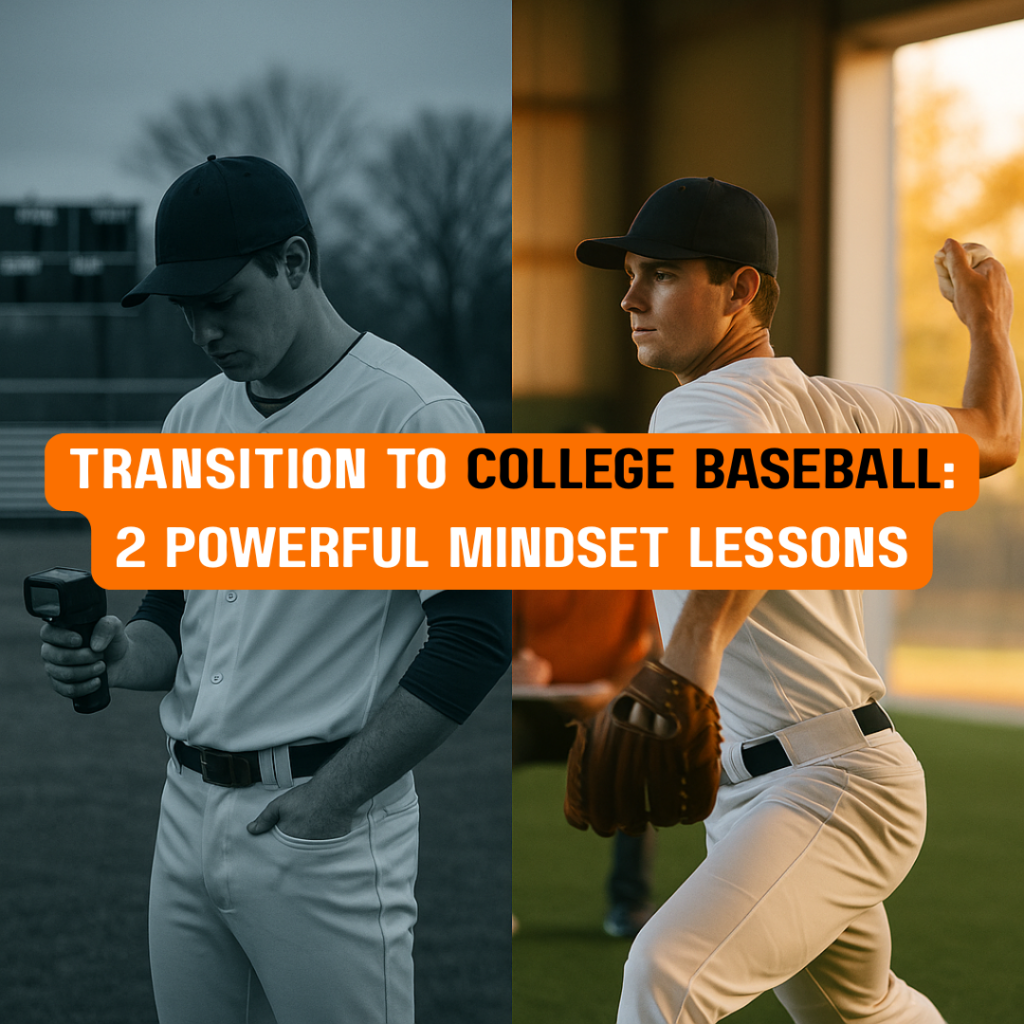
Progress vs. Perfection: Navigating the Transition to College Baseball
“You’re human. You’re not going to be perfect.”
This is one of my go-to lines with young athletes.
First, it’s true.
Second, they need reminding, especially during the transition to college baseball, when the pressure to be perfect can feel overwhelming.
Two Freshman Pitchers, One Velocity Problem
I have two baseball clients with almost identical profiles struggling with not achieving their desired performance outcomes.
Both are freshman Division I baseball pitchers currently on winter break.
Both are competing for innings in the coming season, which starts in mid-February.
Both are concerned about their throwing velocity (i.e., speed) being significantly lower than their best.
Both are concerned that their velocity isn’t good enough to get on the field in the spring.
Why Velocity Isn’t the Whole Story
Let’s be clear: throwing velocity is an important factor in any pitcher’s ability to get batters out. However, it does not guarantee success.
It has been suggested to both of these pitchers by their current coaches that the best way for them to contribute this spring is by throwing strikes.
Despite this, both pitchers are hyper-focused on their velocity.
Their inability to produce their target velocity right now is resulting in negative thoughts and emotions that are impacting their ability to focus on what they can control.
Process and Curiosity Over Perfection
I’ve met with both recently in the midst of their similar challenges.
We’ve discussed that the radar gun reading is almost exclusively out of a pitcher’s control once the ball leaves their hand.
So, I have challenged them to think about what they can do to maximize the chances of achieving their desired result before and while they throw the ball.
I will sum up my advice in two words: process and curiosity.
Can you look at the situation with curiosity in order to find a way to meet this challenge?
What can you do specifically in your processes (i.e., HOW you produce velocity) in order to maximize the chances of success?
Are you able to define success as executing your processes rather than hitting a number on a screen?
Candidly, I’m not sure either is fully bought into this line of thinking yet. However, both intellectually understand the value of thinking about their challenges with a growth mindset.
This is where the hard work begins for them.
Both players accept that their approach to their respective situations is not working.
Both have expressed receptivity to trying the suggestions that I’ve shared.
However, it is unclear if either has the willingness or patience to commit to adopting consistent changes.
The Hidden Challenge in the Transition to College Baseball
The good news is that both pitchers still have six weeks or so before the regular college baseball season starts. If they focus on improvement during this timeframe, then it’s fairly reasonable to assume that they will improve.
The bad news is that the regular college baseball season starts about six weeks earlier than the high school season starts.
I didn’t think about the earlier season start impacting performance until a recent session with one of the players. The light bulb went off for me. “What’s the difference between high school and college baseball?” I asked.
His first answer was the competition level, which is factually true. However, not the answer I was seeking.
The answer was that the season starts six weeks earlier in college.
His body is used to having six extra weeks to get ready. He’s NEVER done this before.
And, most importantly, he is perceiving this as the most important juncture of his baseball career and likely, his life.
With all of that considered, it makes sense that he is putting immense pressure on himself that is negatively affecting his performance now.
Progress Is a Choice, One Day at a Time
The clock is ticking on the upcoming season.
Both players must accept where they are at right now, despite their desire to master the transition to college baseball.
They can choose to commit to new approaches that lead to the improvements they are seeking one day at a time, or they can keep doing things the same way in hopes of seeing different results.
For one pitcher, he must find a way to change his self-talk to maximize his special physical talent. Self-flagellation is not typically an approach that leads to optimal performance.
For the other, he must adopt processes that allow him to execute his pitches with the velocity that he is seeking or accept that he will need to get batters out with 100% of what he actually has in the tank when he’s on the mound.
How Freshman Pitchers Can Prepare for an Earlier Season
If you’re a first-year college baseball player, or the parent of one, the transition to college baseball doesn’t have to feel like a race against the calendar.
Here is what I encourage pitchers to focus on to best navigate the transition to college baseball:
- Define success by your process. Pick two or three process goals for every bullpen, such as tempo, landing position, or finishing the pitch. Judge the session by whether you executed them, not by the radar gun.
- Track what you control. Strike percentage, sleep, recovery, and the quality of your work are all yours. Pitching velocity often follows when those are in place.
- Coach yourself with your words. Replace “I’m too slow” with short, instructional cues like “stay tall” or “drive through the target.” What you say to yourself shapes where your attention goes.
- Get curious instead of critical. After a rough outing, ask what you can learn from it rather than what is wrong with you.
- Clarify your role with your coaches. Ask what they need from you this spring. For many freshman pitchers, the answer is commanding themselves, not trying to prove that they are good enough.
- Reflect after every session. Write down one thing that went well and one thing to adjust. Small, consistent progress beats chasing a perfect outing.
What I Can and Can’t Control as a Coach
I cannot do this for either young man.
All I can do is guide them to potential solutions, reinforce the necessary actions, and hold them accountable for reflecting after the fact.
I will do my part knowing that I only control my process, not the outcomes.
I will also fight the urge to judge my own success based upon both clients’ results. I’m only human after all.
Frequently Asked Questions
When does the college baseball season start?
In NCAA Division I, the regular season typically starts in mid-to-late February. That is often about six weeks earlier than high school seasons, depending on the state, which gives freshman pitchers less time to build up.
Does velocity matter for pitchers in the transition to college baseball?
Yes, but it doesn’t guarantee success. Many college coaches value command and throwing strikes just as much, especially from freshmen competing for innings.
How can freshman pitchers handle the pressure of the transition to college baseball?
Focus on the process instead of results, use constructive self-talk, and reflect after each session. A mental performance coach can help build these habits before the season starts.
Is your athlete navigating the jump to the next level? Subscribe to our newsletter for more mental performance insights, or reach out to talk about one-on-one coaching.
Michael Huber, MA, CMPC® holds a master’s degree in sport psychology. He helps young athletes ages 14 to 22 be themselves when everyone is watching, including learning how to navigate overthinking under pressure. Learn more about Michael.