
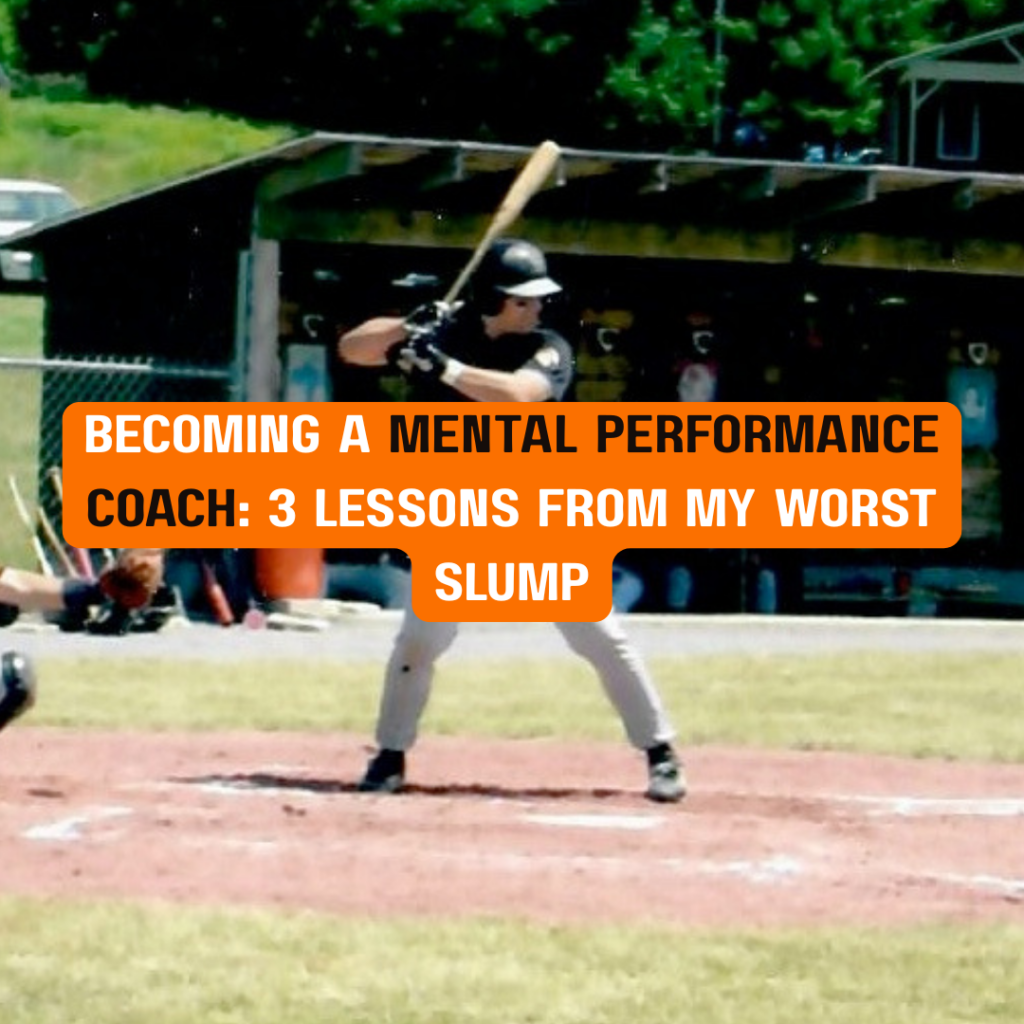
Becoming a Mental Performance Coach: 3 Lessons From My Worst Slump
Why did I swing at that pitch?
I should have crushed that ball.
How can I fix myself?
Those thoughts kept me up at night. Not as a teenager. As a grown man with two kids, a career change in progress, and a neck that was giving out.
Becoming a mental performance coach didn’t start in a classroom for me. It started in a batter’s box. Baseball shaped the way I see young athletes, and it’s the reason I can sit across from one, say “I get it,” and mean it.
Here are three lessons from the game that led me here.
Where Becoming a Mental Performance Coach Started: An 0-for-20 Slump
Sports were my life as a kid. Baseball was my first love.
Then came the spring of 1993. Over three weeks, I went 0-for-20 at the plate. Twenty at-bats. Zero hits. I still remember it as one of the most challenging stretches of my life.
Nobody had a plan for what was happening between my ears. I didn’t have the words for it, let alone the mental tools. I just kept swinging and kept getting in my own way.
My playing career ended after high school… or so I thought.
Lesson One: You Never Really Stop Being an Athlete
About 10 years later, I was working in New York City as a tax consultant. (Yes, I know. Riveting.)
A co-worker, who’s now my best friend, asked me a simple question: “Do you want to play baseball?”
Real baseball? Not softball?
Real baseball. Wooden bats. Central Park.
I hadn’t picked up a bat or a glove in at least five years, since an open tryout in college. I couldn’t say yes fast enough.
It turned out to be one of the best decisions of my life. I made great friends. I traveled to cool places. I played on beautiful fields. I competed against former college and professional players. I’m grateful for all of it.
That’s the first lesson. The identity young athletes build in their sport doesn’t disappear when the uniform comes off. It waits. And it matters, which is why I never tell a young athlete “it’s just a game.”
Lesson Two: Failure Is the Best Teacher of Empathy
Fast forward another 15 years.
I ripped a hard single to left field during a game near my home in New Jersey. It was the last hit of my baseball life. I was already having neurological symptoms that would lead to my second neck surgery months later. At 44, my body was done.
Look at what happened between that first Central Park game and that final single. Two children. A move from New York City to New Jersey. Five different jobs. My first cervical spinal fusion. And the decision to change careers and go back to school for a master’s degree in sport psychology.
All that life, and what kept me up at night was baseball.
In hindsight, that sounds a little crazy, even to me. But I loved it. Playing again made me feel whole, and it gave me closure on the sadness, anger, and regret I carried after my career ended earlier than I wanted.
So, what does a middle-aged man’s final at-bat have to do with your young athlete? A lot.
Hundreds of games. Thousands of at-bats. Fifteen years of slumps, adjustments, and small wins. That’s where my empathy comes from.
I understand how it feels to fail. I understand how hard it is to make an adjustment when your confidence is gone. And I understand how to turn those experiences into something useful for someone else.
Lesson Three: It’s No Longer About Me
Playing baseball again is what pushed me toward becoming a mental performance coach. I wanted to be the person I wish had my back in the spring of 1993.
Self-assessment is part of getting better at anything. You have to look honestly at the good, the bad, and the ugly. When I do that as a coach, I see plenty to improve, but my greatest strength is clear: empathy.
Whether I’m working with an athlete, a performing artist, a parent, or a coach, I have to see the world through their eyes to serve them well. I wrote more about that habit of reflection in Mental Performance Coach Reflections: 10 Powerful Lessons.
Here’s the part that took me the longest to learn. My story is a starting point, not the answer. Becoming a mental performance coach meant pairing my experience with real training, including a master’s degree in sport psychology and the Certified Mental Performance Consultant (CMPC®) credential. That combination lets me help each client find the solutions they need.
What Becoming a Mental Performance Coach Taught Me About Your Young Athlete
If your young athlete is stuck in a slump, overthinking every at-bat, or lying awake replaying a mistake, they’re not broken. They’re human. You’re not going to be perfect, and neither are they.
What they need is someone who sees the game through their eyes. Someone who can help them respond rather than react, and play to win instead of playing not to fail.
When you’re looking for a mental performance coach, look for three things.
One. A real understanding of what your young athlete is going through.
Two. Professional training in sport psychology.
Three. A commitment to confidentiality, so your athlete feels safe opening up. (I explain why that matters in Mental Performance Coach Confidentiality: 3 Vital Questions.)
That’s what becoming a mental performance coach is really about for me: being the person in your athlete’s corner that I needed in 1993.
Frequently Asked Questions
What does a mental performance coach do?
A mental performance coach helps athletes build the mental skills that support performance: managing pressure, handling setbacks, building confidence, and staying focused on what’s important now. The work happens off the field so young athletes can perform their best between the lines.
What does becoming a mental performance coach require?
Most paths include graduate-level education in sport psychology or a related field, mentored hands-on experience, and a certification exam. The CMPC® credential from the Association for Applied Sport Psychology is the only accredited certification for mental performance consultants in North America.
Does a mental performance coach need to have played sports?
No. Training and skill matter most. But personal experience in sport can deepen a coach’s empathy. For me, years of slumps and setbacks help me understand what young athletes feel under pressure.
How can a mental performance coach help an athlete in a slump?
A coach helps the athlete separate results from process, quiet the overthinking, and focus on what they can control. The goal is to respond rather than react, so one bad at-bat doesn’t turn into twenty.
How do I find the right mental performance coach for my child?
Look for professional training, experience with athletes your child’s age, and someone your child feels comfortable talking to. A free consultation is an easy way to see if it’s a fit.
👉 Schedule a free 30-minute consultation now
Michael Huber, MA, CMPC® holds a master’s degree in sport psychology. He helps young athletes ages 14 to 22 be themselves when everyone is watching, including learning how to navigate overthinking under pressure. Learn more about Michael