
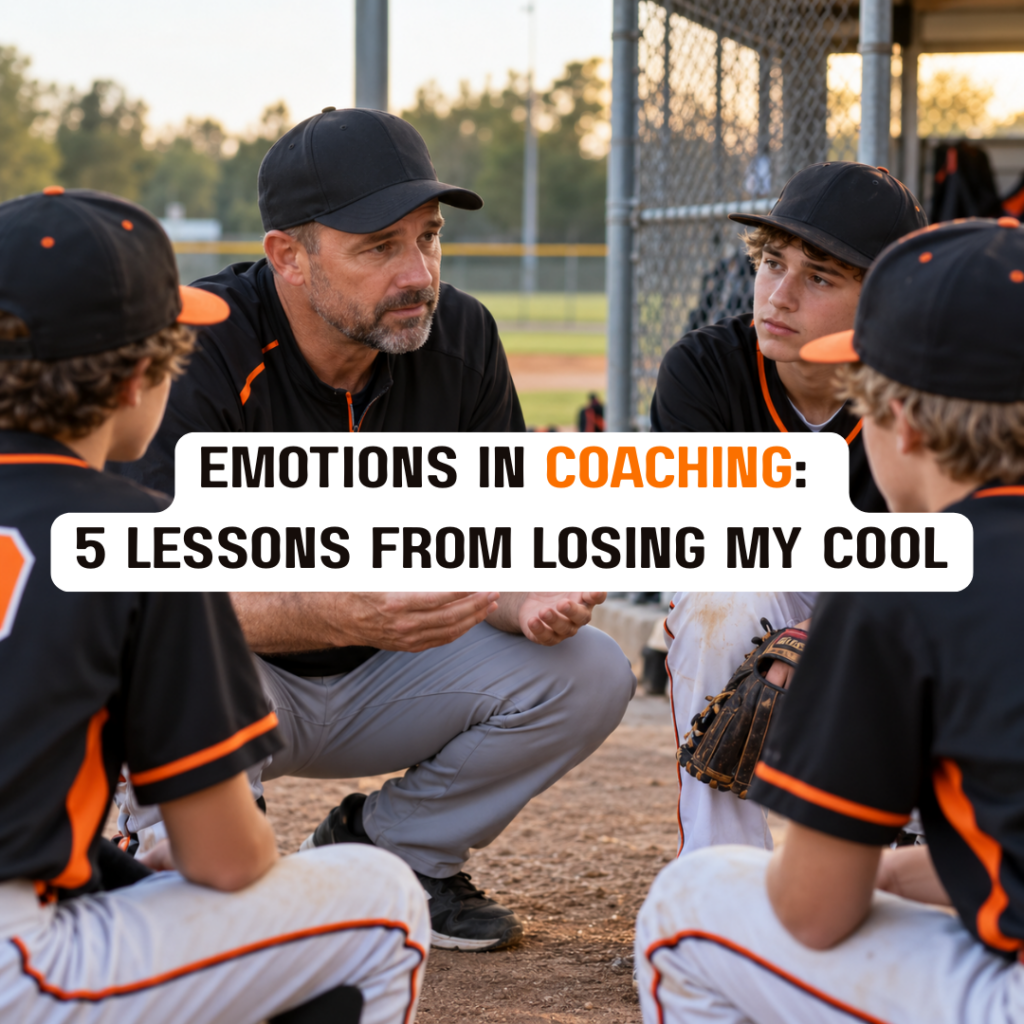
Emotions in Coaching: 5 Powerful Lessons From Losing My Cool
“Show some class.”
I snapped it across the field at the other team’s head coach. It was my 8th grade son’s baseball game, and I was one of the coaches. A few minutes later, in the handshake line, it got worse.
I’m a mental performance coach. I help young athletes manage their emotions under pressure for a living. And I still lost control.
That’s the honest truth about emotions in coaching. They don’t care about your title, your training, or how many times you’ve taught the lesson yourself.
Here’s what happened, why it happened, and five lessons I took from it for coaches and sports parents.
What Happened on the Field
It was a rec (in-house) game a few years ago. We were down about six runs going into the top of the final inning.
Errors.
Passed balls.
A couple of solid hits.
The game slid into mercy rule territory.
I noticed the other team was running on almost every pitch. First to second. Second to third. Home whenever they could. Early in the inning, I didn’t think much of it.
As we got closer to a 10-run game, I paid closer attention. If nothing else, I was frustrated for our players.
It wasn’t just that the other team was running up the score. It was how they were doing it. Players were showboating, for lack of a better word. Spinning around. Walking to the bases to bait throws.
I’ve played more years of baseball than those kids had been alive. My instinct was to get angry, and I could feel it bubbling up.
That’s when I yelled, “Show some class.” On most days, I would have let it go. That day, it irritated me. Badly.
We hit the 10-run limit and kept playing. Our pitcher was out of gas, physically and emotionally. I called timeout to make a change, but we didn’t have any pitchers left. So we called the game.
The Handshake Line
We lined up to shake hands, and I was still fuming. I didn’t say anything to the players. Normally I’d say “good game” or “good job.”
But when I know opening my mouth will make me angrier, I stay quiet.
Then I reached the other head coach. As I extended my hand, he started to explain himself. That triggered me.
“That was f***ing bulls**t,” I said.
Right in front of all the kids.
We shouted back and forth across the field. I used foul language. I acted completely out of character. The moment it ended, I knew I had done the opposite of everything I stand for as a youth sport advocate.
Why Did I Lose Control?
Looking back, I can name at least three reasons.
One. I’d been on edge in my personal life.
Two. Our fielders were making errors, and our pitcher was getting frustrated. I was frustrated too.
Three. The game was running long, and after a long day, I just wanted to go home.
There were probably more. None of them are excuses.
Here’s what bothers me most. I consider emotional intelligence one of my greatest strengths. I’m aware of my own emotions and pretty good at sensing what others feel (you might call it empathy). I’ve spent more than a decade building self-awareness, and my work has given me a healthy perspective on youth sports.
All of that went out the window. Turns out I’m human…
How Do Emotions Affect Coaches?
So, what role do emotions in coaching actually play? A big one.
In a review of the research on emotion in sport coaching, Magrum and McCullick (2019) note that the best coaches understand emotion is “inseparable from and often amplified in sporting contexts.”
Their review also found that coaches tend to be more effective when they can recognize and understand their own emotions, the emotions of others, and the likely effects of their interactions.
In my experience, emotion gets amplified in youth sports too, not just at the elite level. Most of the time, I manage mine well. But it only takes one outburst to sour young athletes’ experience and tarnish your reputation in the community.
The same review points out that when a coach says or does something inappropriate, young athletes notice, and it can hurt their whole sporting experience. I believed that before my meltdown. I believe it even more now.
Emotions in Coaching Are Not an Excuse
Coaches are human. They are not robots.
We get emotional because we’re competitive. Because we want the best for our athletes. Because we care.
Those are valid reasons for losing your cool. They are not excuses. Coaches must hold themselves accountable for poor behavior.
So I apologized, unconditionally, to our team’s parents, my co-coach, and the other team’s head coach. Making timely amends is one of my core values, even when it takes more humility than I’d like to swallow.
The more important apology was to the young men who saw how I acted. I didn’t want my players to think it’s okay to react the way I did. I wanted them to see that it’s okay to own a mistake. Our words matter, but our actions are much more powerful.
I’ve written before about what a TV character can teach us about the coach-athlete relationship. One theme keeps coming up: respect. Adults earn young athletes’ trust by apologizing when they get it wrong. It shows you care.
Trust. Respect. Caring. Those are the things that help a healthy coach-athlete relationship survive the emotional outbursts that will rear their ugly head in youth sports.
What I Planned to Say to My Players
When I sat down to think through that conversation, here’s where I landed.
I’d start with, “I’m sorry for my behavior. It wasn’t cool.”
Then I’d explain why I lost my cool: “I felt you were being disrespected, and it really bothered me.”
And I’d finish with the lesson: “There’s only so much we can control. We can’t control what the other team does. We can only control our reaction to it, and my reaction was poor.”
5 Lessons for Managing Emotions in Coaching
Managing emotions in coaching takes the same mental skills I teach young athletes. Turns out coaches and sports parents need them just as much.
1. Know What You’re Carrying Onto the Field
Stress at home. A long day. Frustration with errors. None of it caused my outburst on its own, but it stacked up. Before the first pitch, take a moment to notice what you’re bringing with you.
2. Pause Before You Speak
My silence in the handshake line was the right instinct. Then I abandoned it. When you feel your emotions bubbling, take a breath and wait until you can respond rather than react.
3. Control the Controllables
“Controlling the controllables” is something I work on with almost every young athlete. It can feel elementary, but the basics matter most. My job was our dugout, not theirs. Instead, I took the other team’s behavior personally and acted like a jerk. (More on this in how control can be a positive function in the coaching equation.)
4. Apologize Quickly and Without Conditions
No “but.” No “I was only upset because…” Own it, out loud, to everyone who saw it. Young athletes learn far more from watching an adult take responsibility than from any speech about accountability.
5. Learn From It, Then Let It Go
We can’t change the past. Dwelling on it is a distraction, because performance happens in the present moment. What’s Important Now? I wouldn’t be practicing what I preach if I kept replaying my worst coaching performance. So I chose to learn from it and write about it. (For more on where attention belongs, see the most effective way to coach focus of attention in baseball.)
Frequently Asked Questions
How do emotions affect coaches?
Emotions in coaching shape how coaches make decisions, communicate, and connect with athletes. Research suggests coaches are more effective when they can recognize and understand their own emotions and those of others. When emotions take over, coaches can react in ways that hurt athletes’ experience.
Is it normal for a coach to lose their temper?
Yes. Coaches are human, and emotions in coaching run high because sports amplify everything. Coaches get emotional because they’re competitive and care about their athletes. Losing your temper is understandable, but it’s not an excuse. The key is to own it and repair it.
How can coaches control their emotions during games?
Managing emotions in coaching starts with knowing your triggers, like stress, fatigue, or frustration with mistakes. Pause and breathe before you speak, focus on what you can control (your own team and your own reaction), and keep your attention on the present moment instead of the last play.
Should a coach apologize to players after an outburst?
Yes. An honest, unconditional apology shows young athletes that adults make mistakes and take responsibility for them. It builds trust and respect, which are the foundation of a healthy coach-athlete relationship.
What does “control the controllables” mean in sports?
It means focusing your energy on what you can influence, such as your effort, attitude, and reaction, instead of what you can’t, like an opponent’s behavior, an umpire’s call, or the scoreboard.
The Bottom Line
Emotions in coaching will never go away. The goal isn’t to stop feeling them. It’s to respond rather than react, and to own it when you don’t.
I’m a firm believer that teaching from experience beats lecturing from a book. Hopefully you agree.
If this post helped you, as a coach or as a sports parent, I’d love to hear from you.
Reference: Magrum, E. D., & McCullick, B. A. (2019). The role of emotion in sport coaching: A review of the literature. The Sport Journal.
👉 Schedule a free 30-minute consultation now
Michael Huber, MA, CMPC® holds a master’s degree in sport psychology. He helps young athletes ages 14 to 22 be themselves when everyone is watching, including learning how to navigate overthinking under pressure. Learn more about Michael