
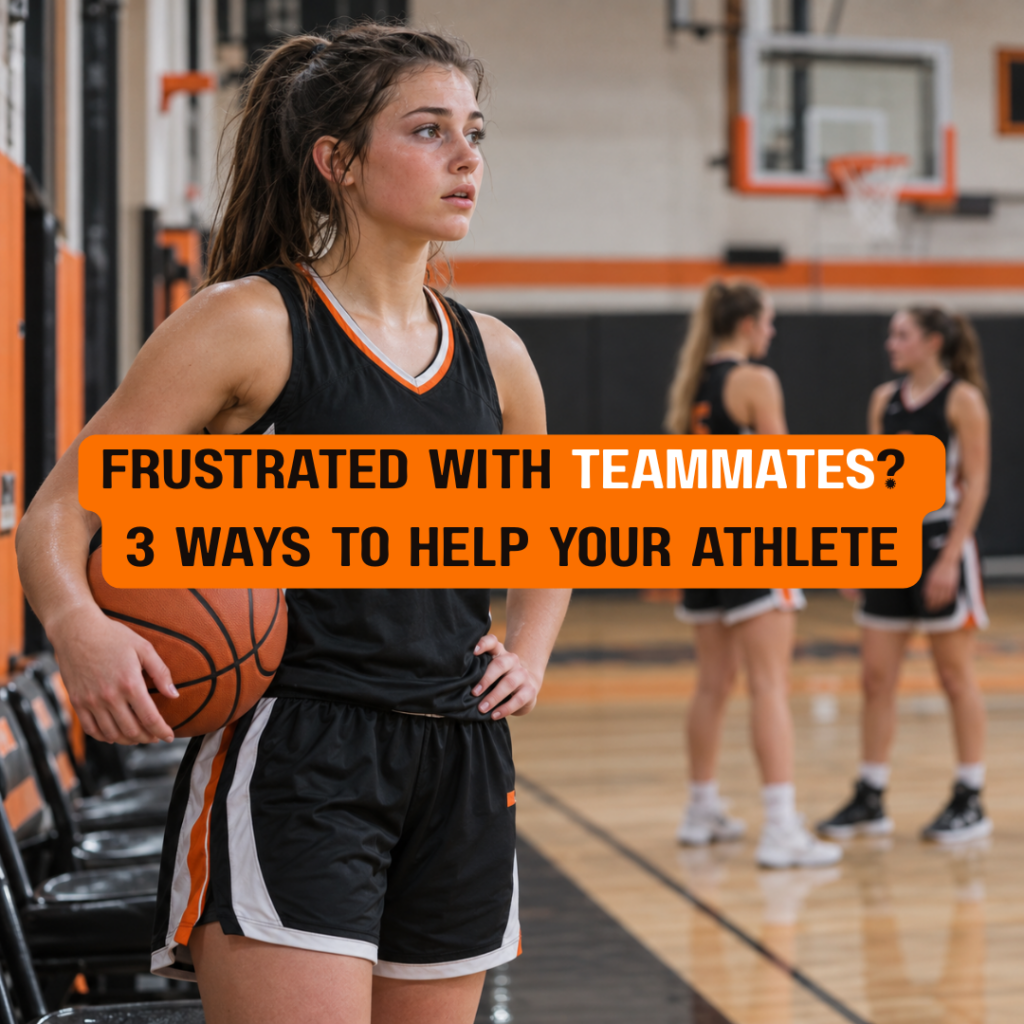
Frustrated With Teammates? 3 Powerful Ways to Help Your Athlete
“If you show her a little bit of care, then she’ll open right up.”
A high school basketball player’s mother told me this recently.
Her daughter (we’ll call her Jenny) is about to start her senior season. She just committed to play Division III college basketball.
You’d think that would take the pressure off.
It hasn’t.
Jenny holds herself to a high standard. She gets frustrated with teammates who don’t share it. And her relationships with her head coach and some of those teammates are shaky, at best.
If your athlete is frustrated with teammates or a coach, this story is for you. At the end, I’ll share three simple ways to help.
Why Starting Before the Season Matters
I recently shared J’s story, about another high school basketball player stuck in the hardest part of recruiting: the wait. That conversation went as well as it did because it wasn’t our first. We’d been building for three years.
Jenny’s family took the same approach.
Most of the time, parents reach out to me mid-season, when something’s already wrong.
Jenny’s parents reached out in August. Her season starts in about a month.
After the last couple of seasons, they didn’t want to wait for the next one to start. They wanted her ready before it did.
That’s the case for offseason mental training (if an offseason even exists anymore).
When a Hard Worker Gets Frustrated With Teammates
Jenny is a tireless worker.
She trains before school. She trains in the evening after practice. She trains on the weekends.
She truly loves basketball.
What she doesn’t love is drama. Or teammates who don’t care as much as she does.
Frankly, they drive her crazy. And she struggles to hide her frustration.
She knows it’s a problem. That awareness is the first step.
But even when we know about a problem, doing something different isn’t easy.
It takes time. It takes experimentation. It takes practice.
And before any of that, it takes care.
Care Comes Before Change
Since August, Jenny has opened up. We went from me doing most of the talking to her doing it. (Sometimes I have to rein her in.)
Because she opened up, we found the real challenge.
It’s not her preparation. It’s not her ability. It’s not the game.
It’s how much attention she gives to the people around her, and how they make her feel when she plays.
Now that I have her buy-in, I can challenge her:
“Yes, these people are annoying. And they’re not going anywhere. So how do you accept it and be your best self anyway?”
That’s where we are right now.
Old Habits Are Hard to Break
I find myself here with a lot of young athletes.
They know what’s going on. They know they want to change it. They’re still figuring out how to change it in a way that works for them.
For Jenny, the old habit is letting her frustration take over when someone gets under her skin.
Gaining her trust is how we get to the solution. It’s also how I earn her parents’ trust.
It’s how we build a partnership. The athlete gets a trusted voice that isn’t their parent’s. The parents get an open line with me.
That kind of partnership isn’t for every family or every coach.
It is for Jenny’s family. And it is for me.
I’m confident Jenny will find a way to turn down the noise and play her best basketball this season, even if the path is a bit winding.
3 Ways to Help When Your Athlete Is Frustrated With Teammates
So, what does this have to do with you?
If your athlete’s season just ended, or the next one is still a few weeks away, now is the best time to start.
Here are three simple ways.
One. Name the noise.
Ask your athlete what pulls their focus when they play.
A teammate? A coach? The scoreboard? Their own mistakes?
You can’t turn down noise you haven’t named.
Psychiatrist Dr. Dan Siegel calls this “name it to tame it.” Putting a feeling into words helps young athletes make sense of it and feel more in control, instead of letting it run the show.
Two. Practice the reset now.
Pick one simple reset, like a deep breath and a cue word, and use it in every offseason workout.
A reset practiced when nothing’s on the line is ready when everything is.
Three. Lead with care.
Jenny’s mom was right.
Before athletes change anything, they need to feel heard. Listen first. The advice can wait.
And if they don’t want to hear it from you right now, that’s normal. Sometimes they need a trusted voice that isn’t yours.
One Challenge This Week
Ask your athlete one question: “What gets in your head when you play?”
Then just listen.
Want a few more ways to practice before the season starts? Start the free 10-day mental game challenge.
Frequently Asked Questions
Why does my athlete get so frustrated with teammates?
Often it’s because they care a lot and hold themselves to a high standard. When teammates don’t match that effort, it feels personal. The frustration usually isn’t about the teammate. It’s about where the athlete is putting their attention.
Should I tell my athlete to just ignore annoying teammates?
Ignoring rarely works, because the more you try not to notice something, the more you notice it. A better goal is acceptance: “This person is annoying, and I can still play my game.” That takes practice, not willpower.
How can I help my athlete stop letting a coach or teammate get in their head?
Start by naming what pulls their focus. Then give them one simple reset, like a breath and a cue word, to practice in every workout. Most of all, listen before you advise.
When is the best time to start mental training?
Before the season, not in the middle of a slump. The offseason gives young athletes time to experiment with new mental skills when nothing is on the line, so they’re ready when it counts.
What does a mental performance coach do that a parent can’t?
A mental performance coach gives your athlete a trusted voice that isn’t yours, plus a structured way to build mental skills. Parents still play a huge role. The best results come from a partnership where everyone stays on the same page.
👉 Schedule a free 30-minute consultation now
Michael Huber, MA, CMPC® holds a master’s degree in sport psychology. He helps young athletes ages 14 to 22 be themselves when everyone is watching, including learning how to navigate overthinking under pressure. Learn more about Michael