
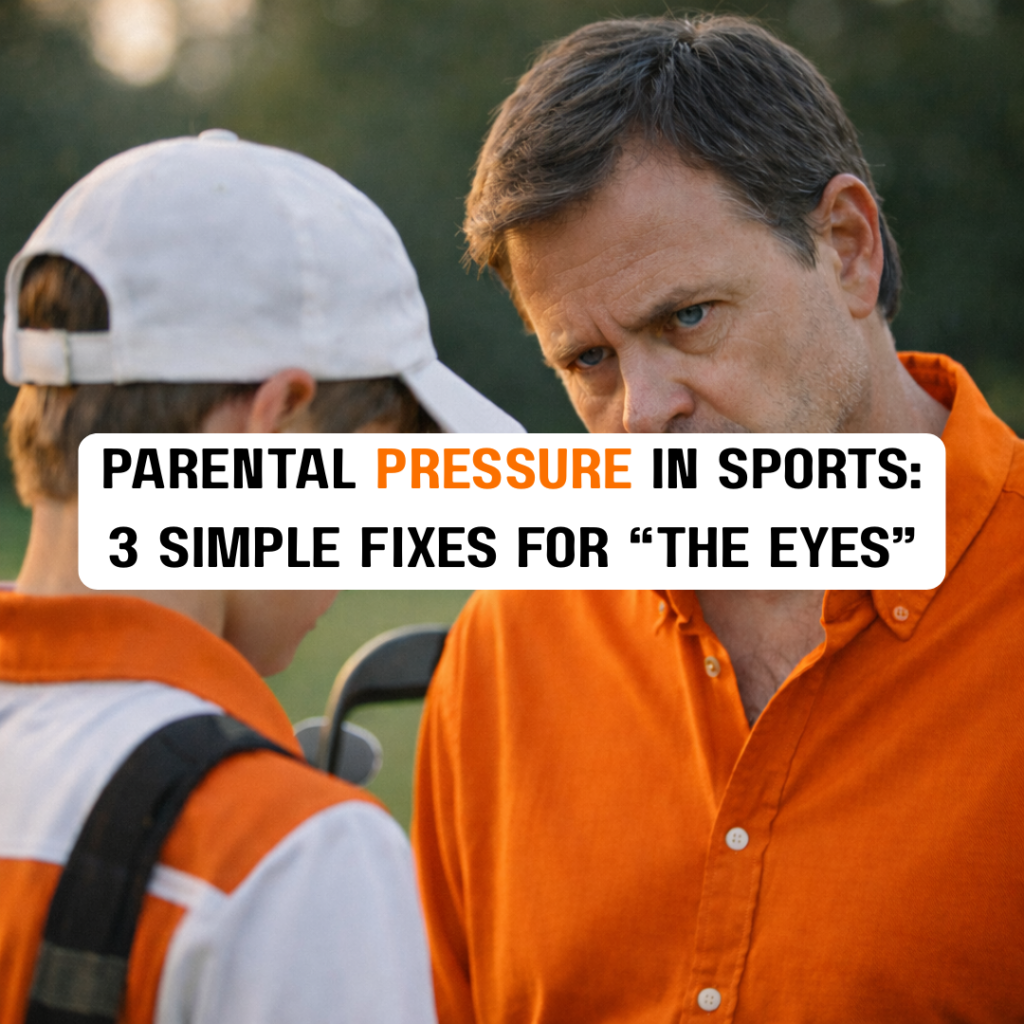
Parental pressure in youth sports isn’t always loud.
Sometimes it’s a single look from the stands.
Last week, one of the young athletes I work with said something that stuck with me.
Not about his swing.
Not about a tournament.
About his dad.
He said:
“Sometimes my dad doesn’t even say anything. He just gives me the eyes.”
If you’ve spent time around youth sports, you know the look.
The one that says:
You should have done something different.
No yelling.
No lecture.
Just the eyes.
And for this athlete, those eyes carry weight.
Because they show up in the moment when he’s already frustrated with himself.
The Situation: A Junior Golfer Feeling Parental Pressure
He’s a competitive junior golfer.
Smart.
Thoughtful.
Self-aware beyond his years.
Sometimes he chooses the safe shot.
Sometimes he chooses the aggressive one.
Just like any golfer.
But when a risky shot doesn’t work out, something happens.
He looks over.
And there they are.
The eyes.
The Real Pressure: A Bad Shot vs. a Bad Decision
During our conversation, he shared something incredibly insightful.
When his dad suggests a shot and it doesn’t work?
“It’s just a bad shot.”
But when he chooses the shot himself and it doesn’t work?
Now it becomes a bad decision.
That difference matters.
Because now he’s not just playing golf.
He’s managing expectations.
And not just his own.
What Happens Next: Hesitation Shows Up in the Swing
He described the next shot like this:
Now he’s unsure.
Should he make his own decision?
Or should he do what his dad suggested?
That hesitation creates resistance.
And resistance eventually shows up in the swing.
Hesitation is one of the most common ways parental pressure shows up in performance. I wrote about a similar pattern in baseball in When Overthinking Under Pressure Takes Over at the Plate.
This Isn’t a Golf Story: Parental Pressure Shows Up in Every Sport
This happens in every sport.
Baseball dugouts.
Soccer sidelines.
Basketball bleachers.
Parents care deeply.
They want to help.
But sometimes athletes end up competing with two opponents:
The game.
And the reaction they’re trying to avoid.
When that happens, performance gets tight.
Research backs this up. A season-long study of youth swimmers in the Journal of Applied Sport Psychology found that parental pressure was linked to the highest anxiety when it came with a focus on winning and outperforming others. When parents emphasized effort, learning, and improvement, the same level of parental pressure was linked to lower anxiety over the season.
The message for parents: what your athlete feels depends on what your reactions say you value.
What the Athlete Actually Wanted
So I asked him a simple question.
“What would you want your dad to do instead?”
His answer was immediate.
“Just support the decision I made and help me move to the next shot.”
Not approval.
Not silence.
Just the freedom to turn the page on his own terms.
A Small Shift That Changes Everything
Parents often believe they are helping athletes.
And many times they are.
But during competition, the bigger need is often something else:
Freedom.
Freedom to make the choice.
Freedom to live with the outcome.
Freedom to learn.
Because the moment athletes feel responsible for the decision, something powerful happens.
It becomes their idea.
Then they commit.
And commitment is where confidence grows. (For another example of that, read how one basketball player became “like a new kid” by focusing on what he could control.)
A Question for Parents
Next time your athlete makes a decision that doesn’t work out, notice your reaction.
Even the subtle ones.
Especially the eyes.
Because the smallest reactions can shape the pressure athletes carry into the next play.
And sometimes the most helpful thing a parent can do is simple:
Help them turn the page.
3 Modest Reminders to Ease Parental Pressure
Most parental pressure is unintentional. These three reminders help keep it from following your athlete onto the field, the court, or the course.
1. Ask your athlete what they need from you.
Don’t assume your child wants advice during competition.
Even when your input is valid, they may not experience it that way in the moment.
Sometimes what they need most isn’t instruction.
It’s unconditional support.
A simple place to start: ask, “What do you need from me when you’re competing?” Then listen. These 3 questions to ask before you try to fix it can help with that conversation.
2. Have a plan for your own emotions.
Even when you understand your athlete’s expectations, you won’t manage every moment perfectly.
You’re human.
Frustration happens.
Have a plan to reset when it does. If you need ideas, here are 3 proven tools for the sports parent’s mental game.
3. Be accountable.
If you let your emotions get the best of you, acknowledge them.
Take responsibility.
Apologize if the situation warrants.
That simple act builds trust and makes future challenges easier to navigate together.
Want Help Turning Down the Pressure?
If you see parental pressure showing up in your athlete’s game, or in your own reactions, you don’t have to sort it out alone. Book a 30-minute call here, or read Does My Athlete Need a Mental Performance Coach? to see if coaching is a good fit.
***
Michael Huber, MA, CMPC® holds a master’s degree in sport psychology. He helps young athletes ages 14 to 22 be themselves when everyone is watching, including learning how to navigate overthinking under pressure. Learn more about Michael.